Learn smarter with fresh insights from our tutors.
Practical study guides, course supplements, and learning resources curated to help you move faster through every subject.
The Startup Revolution: How Tech is Disrupting Industries

The Startup Revolution: How Tech is Disrupting Industries
The world is buzzing with innovation, and the startup revolution is at the heart of it all. Entrepreneurs are shaking up traditional industries, driven by technology and fresh ideas. From ride-sharing apps that challenge taxi services to platforms that transform how we shop, these disruptive startups are redefining norms and creating new opportunities.
Imagine a landscape where every industry faces a shake-up; that's what we're witnessing today. The rise of tech-savvy entrepreneurs is not just changing how we consume but also how businesses operate. With each new idea comes the potential for transformation, making this an exciting time for both consumers and innovators alike.
Curious about how this revolution works? Let’s explore its dynamics, success stories, challenges faced by newcomers in the field, and what lies ahead in this exhilarating journey of disruption!
Understanding the Startup Revolution
The startup revolution is about more than just new businesses; it embodies a mindset. It's fueled by creativity, agility, and a willingness to challenge the status quo.
Entrepreneurs today leverage technology to solve real-world problems. They are not afraid of risk or failure. Instead, they view challenges as opportunities for innovation.
Global connectivity has democratized access to resources. With online platforms, aspiring founders can find funding and mentorship from anywhere in the world. This shift has lowered barriers that once hindered entry into various markets.
Moreover, consumer behavior is evolving rapidly. People are seeking personalized experiences over one-size-fits-all solutions. Startups respond quickly to these demands with tailor-made offerings that resonate on a deeper level.
As traditional companies scramble to keep pace, startups continue breaking ground across different sectors—forever altering how we live and work.
Success Stories of Disruptive Startups
Airbnb transformed the hospitality industry by connecting travelers with locals. What started as a simple idea to rent out air mattresses in a living room has grown into a global phenomenon. This platform disrupted traditional hotel models, offering unique experiences at various price points.
Uber's impact on transportation is equally striking. By using an app-based system, it reshaped how we think about getting from point A to B. The convenience of hailing a ride from your phone caught on quickly, prompting cities worldwide to rethink regulations and public transport options.
Then there's Warby Parker, which altered the eyewear market. They cut out middlemen and offered stylish frames online for affordable prices. Customers could try before they buy through their home try-on program, changing shopping habits forever.
These success stories highlight how innovative thinking can turn industries upside down while creating better solutions for consumers everywhere.
How Technology is Changing Traditional Industries
Technology is redefining traditional industries at a rapid pace. Automation and AI are streamlining processes that once relied heavily on human labor. This shift not only boosts efficiency but also reduces costs for businesses.
In agriculture, precision farming uses drones and sensors to monitor crop health. Farmers can now make data-driven decisions, leading to higher yields and minimal waste.
The retail sector is embracing e-commerce platforms as online shopping becomes the norm. Brick-and-mortar stores are adapting by integrating digital experiences to attract modern consumers.
Health care has seen an influx of telemedicine solutions, allowing patients access to services from the comfort of their homes. This change enhances patient engagement while optimizing resource allocation in medical facilities.
Education is another field undergoing transformation through online learning platforms. Students can access quality resources globally, breaking geographical barriers previously faced by traditional institutions.
The Benefits of Disruption for Consumers and Businesses
Disruption brings fresh perspectives to traditional markets. Consumers often find better products at lower prices due to increased competition. This shift encourages companies to innovate.
For businesses, disruption can spark new revenue streams. Startups challenge established players, pushing them to adapt or risk becoming obsolete. This evolution drives efficiency and creativity across sectors.
Moreover, technology enables personalized experiences that cater directly to consumer needs. Businesses leveraging data analytics can tailor their offerings uniquely.
The rise of disruptors also fosters community engagement. Local startups can resonate more with consumers than larger corporations ever could.
Both consumers and businesses benefit from a landscape rich in innovation and choice, leading to improved satisfaction on all fronts.
Challenges Faced by Disruptive Startups
Disruptive startups often encounter a myriad of challenges that can hinder their progress. One major hurdle is securing funding. Traditional investors may be hesitant to back ideas that challenge established norms.
Regulatory hurdles also pose significant obstacles. Many industries have strict regulations, and navigating this landscape is often daunting for newcomers. Compliance can drain resources and slow growth.
Market acceptance is another tough battle. Consumers tend to be skeptical about new technologies or services, especially if they disrupt long-standing habits.
Talent acquisition remains critical yet challenging as well. Startups must attract skilled professionals who share their vision while competing against well-established companies offering more stability.
The rapid pace of technological change means disruptive startups must continuously innovate to stay relevant in an ever-evolving market landscape, making agility crucial but difficult to maintain over time.
Tips for Entrepreneurs Looking to Enter the Startup World
Entering the startup world can be exhilarating yet daunting. Start by identifying a problem worth solving. A genuine need in the market is your starting point.
Next, build a strong network. Connect with mentors, fellow entrepreneurs, and industry experts. Their insights can save you from common pitfalls.
Embrace flexibility in your plans. The landscape changes quickly; adaptability is key to survival and growth.
Focus on creating a minimal viable product (MVP). Test your concept with real users early on to gather feedback and iterate swiftly.
Don’t underestimate marketing—understanding your audience is essential for success. Use social media strategically to engage potential customers before you launch.
Keep learning constantly. Attend workshops or webinars related to entrepreneurship and technology trends that could impact your field. Educating yourself continuously will help you stay ahead of the curve and foster innovation within your startup journey.
The Future of the Startup Revolution
The future of the startup revolution is bursting with potential. As technology evolves, so do opportunities for innovative solutions. Emerging fields like artificial intelligence and blockchain are reshaping how businesses operate.
Entrepreneurs will harness these advancements to create smarter products and services. With greater access to global markets, startups can scale faster than ever before. This interconnectedness fosters collaboration across borders, enabling diverse ideas to flourish.
Consumer preferences are shifting too. People now seek personalized experiences over one-size-fits-all offerings. Startups that adapt quickly will thrive in this dynamic landscape.
Sustainability is also becoming a priority. Eco-conscious entrepreneurs are stepping up to meet market demands while addressing climate change challenges.
As we look ahead, the startup ecosystem promises excitement and transformation, driven by those daring enough to innovate boldly.
Conclusion
The Startup Revolution is more than just a trend; it’s reshaping how we think about business and innovation. Tech-driven startups are challenging the status quo of established industries, demonstrating that agility and creativity can lead to groundbreaking solutions.
As consumers, we benefit from increased choices and improved services. Businesses also gain an opportunity to rethink their strategies, embracing change rather than resisting it. The landscape is evolving rapidly, fueled by technology that continues to advance at an unprecedented pace.
Yet this journey isn't without its hurdles. Disruptive startups often navigate a maze of challenges—from securing funding to overcoming regulatory barriers. Entrepreneurs must stay adaptable and resilient in the face of obstacles while keeping their vision clear.
For those looking to join the startup ecosystem, understanding market needs and harnessing technology will be key components for success. Embrace collaboration over competition, innovate fearlessly, and remain open-minded as you shape your entrepreneurial path.
Looking ahead, it's exciting to imagine where this revolution might take us next. As new technologies emerge and consumer preferences shift further into digital realms, opportunities abound for disruption across different sectors.
This ever-evolving narrative invites everyone—entrepreneurs and investors alike—to engage deeply with what lies ahead in the world of startups.
The Future of Work: How Automation will Change Jobs

The Future of Work: How Automation will Change Jobs
The workplace is evolving at a dizzying pace, driven by an unstoppable force: automation. From robots on factory floors to AI-powered chatbots assisting customers, technology is reshaping the way we work. While some see this as a threat to jobs, others view it as an opportunity for innovation and growth.
As we navigate this new landscape, questions arise about what the future holds for our careers and industries. Are we on the brink of mass unemployment or entering a golden age of productivity? Join us as we explore how automation will change jobs forever and what it means for you in this shifting environment.
The Rise of Automation
Automation has surged to the forefront of technological advancements in recent years. Businesses are increasingly adopting smart solutions that enhance efficiency and reduce costs.
From self-checkout kiosks in grocery stores to automated manufacturing processes, the signs are everywhere. Consumers now expect speed and convenience, pushing companies to innovate rapidly.
As artificial intelligence continues to develop, automation is becoming more sophisticated. It’s no longer limited to repetitive tasks; machines can learn from data and adapt their functions accordingly.
The pandemic further accelerated this trend as organizations sought resilience through digital transformation. Many realized that embracing automation could safeguard against future disruptions while meeting changing demands.
With each passing day, it becomes clearer: automation isn’t a fleeting trend but a fundamental shift shaping tomorrow’s workforce dynamics. The rise of automation is not just about technology—it's a glimpse into how we will work together with machines moving forward.
What is Automation and How Does it Work?
Automation refers to the use of technology to perform tasks with minimal human intervention. It involves programming machines and software to execute repetitive processes efficiently.
At its core, automation relies on algorithms and artificial intelligence. These systems analyze data, make decisions, and adapt based on outcomes. This allows them to streamline workflows across various sectors.
From robotic arms in factories assembling products to chatbots handling customer inquiries online, automation can be found everywhere today. It enhances productivity by increasing speed and accuracy while reducing errors.
The beauty of automation lies in its versatility. Whether it’s managing supply chains or optimizing marketing efforts, it transforms traditional methods into seamless operations. As we delve deeper into this technological shift, understanding how these systems work is crucial for adapting our strategies moving forward.
Impact on Different Industries: Retail, Manufacturing, Healthcare, etc
Automation is transforming various industries at an unprecedented pace. In retail, self-checkout kiosks and AI-driven inventory systems enhance efficiency while reducing labor costs. Shoppers enjoy a faster experience, but traditional cashiers face uncertainty.
Manufacturing has embraced robotics for assembly lines. Machines handle repetitive tasks with precision, leading to increased productivity. However, this shift means that workers must adapt to new roles focused on oversight and maintenance.
Healthcare is witnessing automation in diagnostics and patient management. Robots can assist in surgeries or manage medication schedules, improving accuracy and freeing up professionals for complex decisions. Yet this raises questions about the human touch in caregiving.
These changes are reshaping job functions across sectors. Workers need to be agile as they navigate evolving demands brought about by technological advances.
Job Losses vs Job Creation
The debate around job losses versus job creation due to automation is complex. While some fear that machines will eliminate jobs, the reality is more nuanced.
Many traditional roles may disappear, particularly those involving repetitive tasks. However, history shows that new technologies often lead to the emergence of entirely new fields.
For instance, as robotic assembly lines rise in manufacturing, there’s an increasing demand for skilled technicians who can maintain and program these systems. The healthcare industry also illustrates this shift well; while certain administrative roles might diminish, positions focusing on telehealth and data analysis are flourishing.
Transitions won’t be instant or easy; workers will need support during these changes. Upskilling initiatives and vocational training programs can help bridge the gap between current skills and future demands.
The challenge lies not just in preserving existing jobs but in fostering an adaptable workforce ready for whatever comes next.
Preparing for the Future: Education and Skills
As automation continues to reshape the workforce, the importance of education and skills cannot be overstated. Traditional roles are evolving, making lifelong learning essential for career longevity.
Individuals must embrace adaptability. Online courses, workshops, and boot camps offer flexible options to upskill or reskill. Areas like coding, data analysis, and digital marketing will see increasing demand.
Soft skills remain invaluable in this new landscape. Communication, creativity, and emotional intelligence set candidates apart from machines. Employers increasingly seek workers who can collaborate effectively within diverse teams.
Networking also plays a crucial role in staying relevant. Engaging with industry professionals opens doors to opportunities that may not be advertised elsewhere.
Investing time in personal growth ensures readiness for the shifts ahead. By prioritizing continuous learning now, individuals position themselves at the forefront of their fields as technology evolves.
Ethical Concerns Surrounding Automation
The rise of automation brings forth a myriad of ethical dilemmas. As machines take over tasks traditionally performed by humans, questions about fairness and accountability arise.
One major concern is bias in algorithms. Automated systems often reflect the prejudices inherent in their programming or training data. This can lead to discriminatory practices in hiring or lending, impacting marginalized groups disproportionately.
Privacy issues also loom large. With increased surveillance through automated systems, personal data may be collected without consent, raising alarms about individual rights and freedoms.
Moreover, the displacement of workers leads to moral questions about responsibility. Should companies provide retraining programs for employees whose jobs are rendered obsolete? Or should society bear that burden?
These concerns necessitate open dialogues among policymakers, businesses, and communities to navigate this evolving landscape thoughtfully. Addressing these ethical challenges will shape a fairer future as we embrace automation's potential.
Embracing Change in the Workplace
Change can be unsettling, but it also opens doors to innovation. Embracing automation in the workplace presents an opportunity to enhance productivity and creativity.
Employees should focus on adapting their mindsets. Viewing technology as a partner rather than a threat can shift perspectives dramatically. This mindset fosters collaboration between humans and machines.
Encouraging a culture of continuous learning is vital. Organizations that invest in training help employees feel equipped for new challenges. Upskilling not only boosts confidence but also drives engagement.
Flexibility becomes key in this evolving landscape. Companies must remain agile, adjusting roles and responsibilities as needed while nurturing an adaptable workforce.
Cultivating resilience through change helps create dynamic environments where everyone thrives together. The future isn't something to fear; it's an invitation to grow collectively within our workplaces.
Conclusion
As we navigate the evolving landscape of work, it’s clear that automation will play a significant role in shaping our future. While some jobs may become obsolete, new opportunities will emerge. The key is to adapt and embrace these changes with an open mind.
Education and training will be crucial as we shift toward a more automated workforce. Workers need to acquire skills that complement technology rather than compete against it. Emphasizing critical thinking, creativity, and adaptability can help individuals thrive amidst technological advancements.
Ethical considerations also demand our attention. It's vital to ensure that the benefits of automation are shared equitably across society. This means addressing potential inequalities and ensuring workers have access to retraining programs.
Change can be daunting but also exciting. By embracing innovation, organizations can create a dynamic workplace where humans and machines collaborate successfully.
The future holds great promise if we approach it thoughtfully and strategically. Preparing for this transformation now sets the stage for a better work environment tomorrow.
The Future of Transportation: Electric and Autonomous Vehicles

The Future of Transportation: Electric and Autonomous Vehicles
The world of transportation is on the brink of a revolution. Imagine gliding silently through city streets in an electric vehicle, or relaxing while your car navigates traffic with no input from you. Electric and autonomous vehicles are not just futuristic dreams; they are becoming a reality and reshaping how we think about travel.
As technology advances at lightning speed, these innovations promise to redefine convenience and efficiency in our daily commutes. The shift toward cleaner energy sources combined with cutting-edge automation could change everything—from urban planning to personal mobility.
Join us as we explore what electric and autonomous vehicles mean for our roads, society, and environment in the coming years. Buckle up—it's going to be an exciting ride!
Understanding Electric and Autonomous Vehicles
Electric vehicles (EVs) run on electricity instead of traditional gasoline or diesel. They use rechargeable batteries, which can be charged at home or at public stations. This shift not only reduces air pollution but also decreases reliance on fossil fuels.
Autonomous vehicles, often referred to as self-driving cars, utilize a combination of sensors, cameras, and artificial intelligence to navigate. These systems allow the vehicle to detect its surroundings and make real-time decisions without human intervention.
The fusion of these technologies creates a new transportation paradigm. Imagine cars that are both eco-friendly and capable of driving themselves safely through busy streets.
As we delve deeper into this evolution, understanding how each component works is essential for grasping their potential impact on our lives and cities. The possibilities are vast—and they’re closer than you might think.
The Benefits of Electric and Autonomous Vehicles
Electric and autonomous vehicles are transforming the way we think about transportation. Their potential benefits extend far beyond just convenience.
First, they offer significant environmental advantages. By reducing reliance on fossil fuels, electric vehicles help lower greenhouse gas emissions. Cleaner air leads to healthier communities.
Cost savings also play a vital role in their appeal. Electric cars have fewer moving parts than traditional engines, leading to reduced maintenance costs over time. Additionally, electricity is often cheaper than gasoline.
Safety features in autonomous vehicles can’t be overlooked either. With advanced sensors and AI technology, these cars aim to minimize human error—one of the main causes of accidents today.
There’s an element of accessibility that shouldn’t be ignored. Autonomous vehicles could provide mobility solutions for those who currently struggle with transportation options—like the elderly or disabled individuals—enhancing their independence and quality of life.
Challenges and Limitations
Electric and autonomous vehicles face several challenges that could hinder their widespread adoption. One prominent issue is the infrastructure needed to support them. Charging stations for electric cars are still limited in many areas, making long-distance travel a concern.
Autonomous vehicles also grapple with regulatory hurdles. Governments worldwide are still figuring out how to legislate this new technology. Different jurisdictions have varying rules, complicating development and deployment.
Safety remains a critical concern as well. High-profile accidents involving self-driving cars raise questions about reliability and public trust. Developers must ensure robust systems that can handle diverse driving conditions.
Public perception plays a significant role too. Many consumers remain skeptical about transitioning from traditional vehicles to electric or self-driving options due to misconceptions or lack of knowledge about the benefits these technologies offer.
The Evolution of Electric and Autonomous Vehicles
The journey of electric and autonomous vehicles dates back over a century. Early electric cars gained popularity in the late 1800s, showcasing their potential for quiet and efficient travel. However, gasoline engines soon took center stage.
Fast forward to the late 20th century, when concerns about pollution sparked renewed interest in electric technology. Innovations led to more practical battery designs and charging solutions.
Simultaneously, advancements in artificial intelligence began transforming how we interact with machines. The integration of AI into vehicle systems paved the way for autonomy.
Today’s landscape features companies racing to refine these technologies. From Tesla's pioneering efforts to traditional automakers embracing change, competition drives rapid progress.
As regulations evolve alongside consumer demand, both electric and autonomous vehicles are set to reshape our roads dramatically. What started as an intriguing concept is now becoming integral to modern transportation strategies worldwide.
Current Use in Transportation Industry
Electric and autonomous vehicles are already making waves in the transportation industry. Cities around the world are integrating electric buses into their public transit systems. These eco-friendly options reduce emissions and offer quieter rides for commuters.
Ride-sharing companies are also embracing this shift. Many now feature electric vehicles as part of their fleets, promoting sustainability while meeting growing consumer demand for greener alternatives.
Autonomous delivery services have gained traction too. Companies like Amazon and Google experiment with self-driving vans and drones to optimize logistics. This innovation speeds up deliveries while cutting costs.
Meanwhile, car manufacturers invest heavily in developing fully autonomous cars. Pilot programs are underway in select cities, allowing consumers to experience driverless technology firsthand.
This transformation is just beginning, yet its impact can already be felt across various sectors within transportation.
Predictions for the Future of Electric and Autonomous Vehicles
The landscape of electric and autonomous vehicles is poised for significant transformation. As battery technology improves, we can expect longer ranges and faster charging times. This will make electric cars even more appealing to the average consumer.
Autonomous driving systems are likely to become mainstream in urban areas first. With advancements in AI and machine learning, these vehicles will navigate complex environments with greater efficiency.
Shared mobility services may rise as well, blending electric vehicle technology with ride-hailing platforms. Imagine cities where personal car ownership declines, making way for fleets of self-driving taxis.
Regulatory frameworks will evolve too, addressing safety concerns while promoting innovation. Local governments might incentivize the use of green technologies through subsidies or infrastructure improvements.
As public perception shifts towards acceptance, we could see a surge in demand for eco-friendly transportation options that prioritize sustainability over traditional fossil fuels.
Impact on Society, Economy, and Environment
Electric and autonomous vehicles are set to create a ripple effect across various aspects of life. As these technologies become mainstream, urban landscapes may transform dramatically. Car ownership could decline, leading to less congestion and more green spaces.
Economically, new industries will emerge around EV charging infrastructure and smart vehicle technology. Job opportunities in tech development, manufacturing, and service sectors might increase as demand grows.
On the environmental front, reduced emissions from electric vehicles can significantly improve air quality in cities. This shift also supports global efforts to combat climate change by lowering greenhouse gas emissions.
Furthermore, autonomous vehicles promise safer roads with fewer accidents caused by human error. This newfound safety could lead to decreased healthcare costs associated with traffic incidents while promoting greater mobility for those unable to drive themselves.
Such advancements foster a society that prioritizes sustainability while enhancing the overall quality of life.
Conclusion
The future of transportation is undeniably tied to the advancements in electric and autonomous vehicles. These technologies promise a shift that could redefine how we think about mobility. As electric vehicles become more mainstream, their environmental benefits will increasingly resonate with consumers, spurring further adoption.
Autonomous driving technology stands on the brink of revolutionizing our daily commutes. With enhanced safety features and increased efficiency, these innovations have the potential to reshape urban landscapes. However, challenges remain—regulatory hurdles and public perception must be addressed for widespread acceptance.
As we look forward, it’s clear that both sectors are evolving rapidly. The integration of smart infrastructure will likely play a pivotal role in facilitating this transformation. Investments from governments and private entities signal strong support for these initiatives.
The impact on society cannot be overstated; from reduced traffic congestion to lower carbon emissions, the ripple effects are profound. Economic shifts may arise as new job opportunities develop alongside traditional roles evolve within this changing landscape.
Electric and autonomous vehicles aren’t just trends—they represent a necessary evolution in transportation that aligns with broader goals for sustainability and innovation. Adapting to these changes holds great promise for individuals and communities alike as we journey into an exciting new era of mobility.
The Particulate Nature of Matter
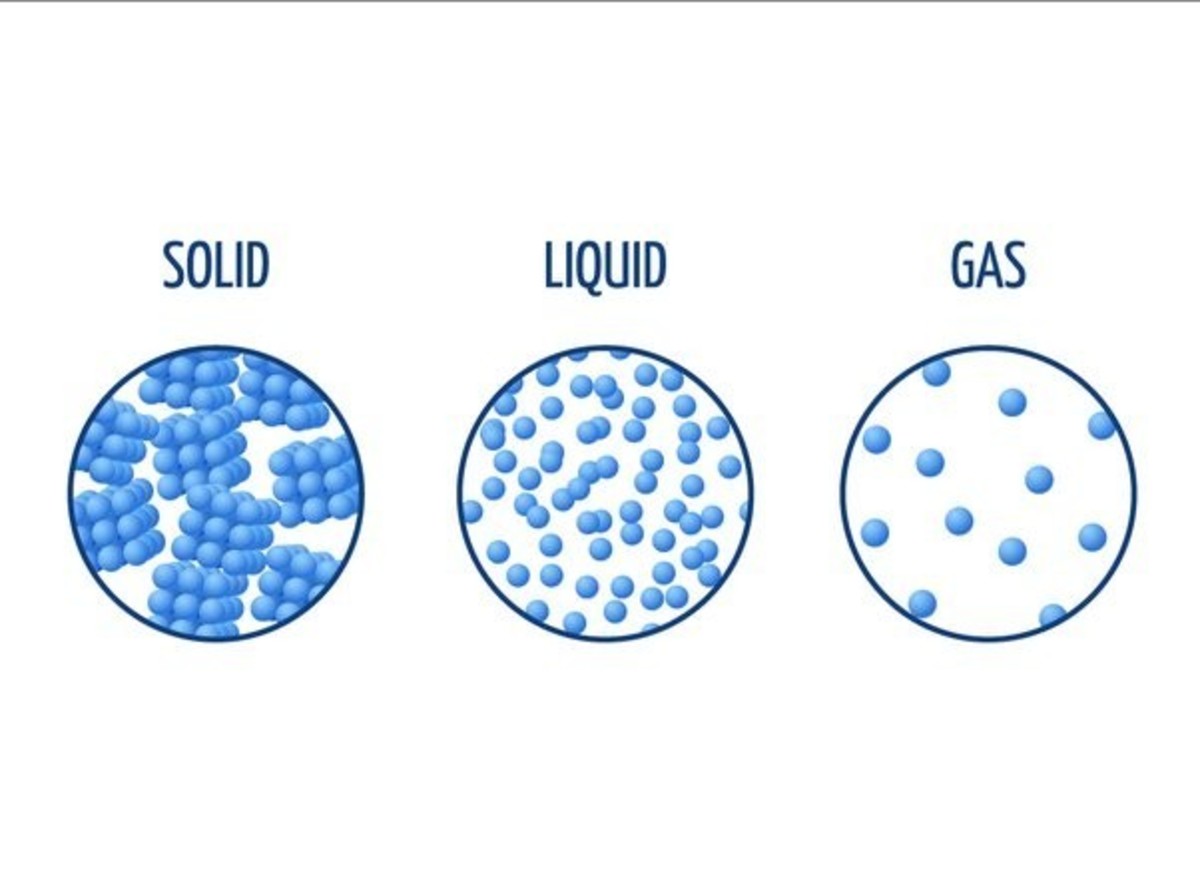
Particulate Nature of Matter
The Particulate Nature of Matter
The kinetic theory is a scientific model which helps us to explain how the arrangement of particles relates to the properties of the three states of matter, which are solid, liquid and gas. Chemistry helps us to understand and know how matter is like and how it behaves and this helps us to predict how different matters could behave under different conditions. Much as this is the case, the big question remains as what is matter? Matter can be defined as all substances and materials from which the physical universe is composed of, and they can be categorized as solids, liquids or gases
Kinetic Theory of Matter
As of today, there are numerous evidences which explains that all matter is made up of tiny particles and the kinetic theory helps us to explain the way in which different types of Matter behaves and this relate to physical properties of matter.
Key points of the Kinetic Theory of Matter can be summarized as follows:
- All the three states of matter are made up of tiny particles which move at a constant rate, and are invisible to the naked eye. It should be noted that different substances are made up of different types of particles, which are atoms, molecules or ions, which have different sizes.
- The particles in all the three states of matter move all the time and the rate at which they move depends on the amount of temperature such that the higher the temperature, the faster they move on average.
- The rate at which the particles move in all the three states of matter depends on weight of particles, thus the heavier particles the slower they and the lighter the particle, the faster they move.
Explaining the States of Matter
Solid
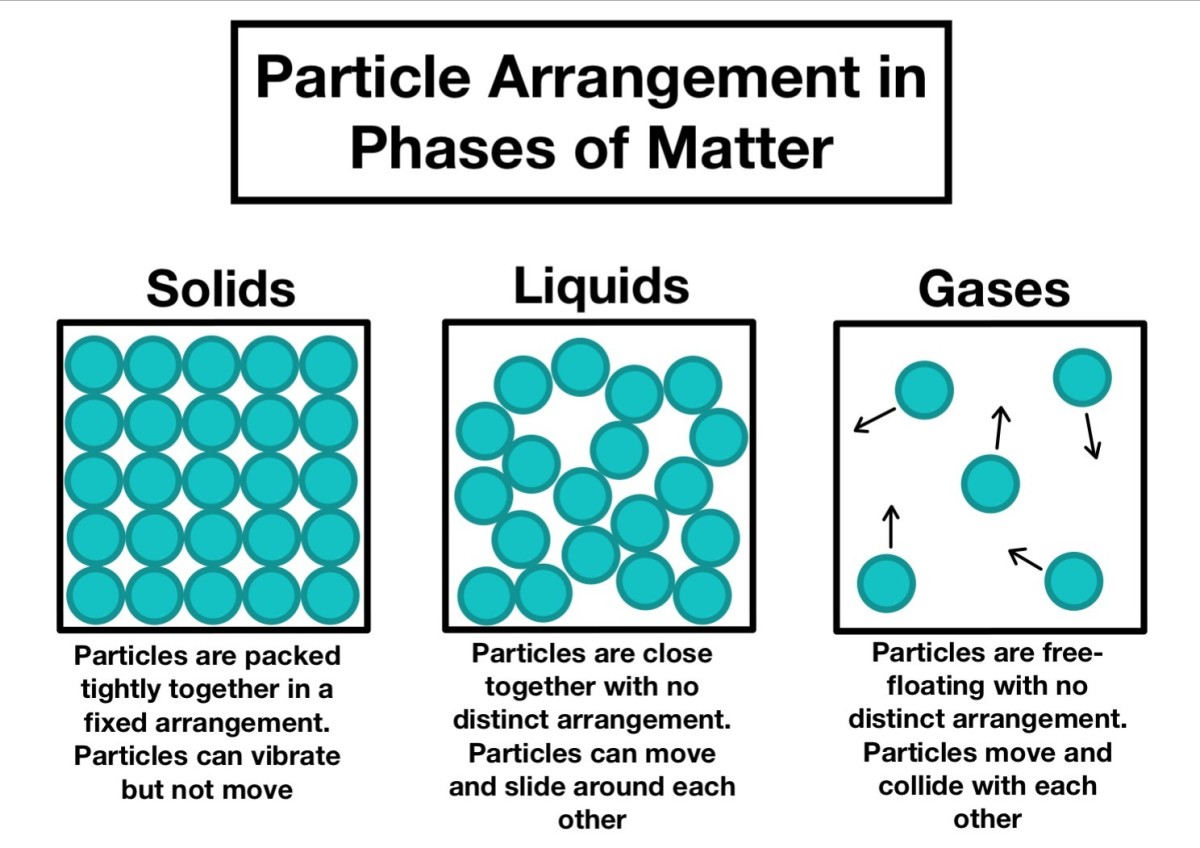
- The particles attract one another in solid and there are strong forces of attraction which hold them close together, and this makes them incompressible.
- Particles in solid have little freedom of movement unlike in the other state of matters and can only vibrate on a fixed position.
- They have a regular shape because they are arranged in a regular form and this explains why many solids form crystals.
- All solid, have a definite shape and volume at a given temperature, which may be affected by changes in temperature. Solids expand when heated and contracted when cooled.
Liquid
- Particles in liquid are close together, but they randomly move around and often collide with each other.
- Liquid has a weaker force of attraction comparing them to that of solid and particle in a liquid are known to have more energy than that of the solid.
- Just as in solids, particles in liquid expand when heated and contracted when cooled.
- In liquid at any given temperature, it tends to have a fixed volume and takes the shape of the container in which they are put. Any change in temperature, affects their volume, just like in solid.
Gas
- Unlike in solid and liquid, in a gas the particles are relatively far apart and they move freely anywhere within the container in which they are held and this makes them to fill the space in which they are put.
- Their particles move in a random order and they do so at very high velocities and more rapidly than those in a liquid.
- Particles in gas collide with each other, but not as often as in liquids.
- Their particles have no forces of attraction and are far apart, making them to exist virtually.
- At a given temperature, gas has neither a fixed nor a definite volume and it will correspond by taking the shape of the any container into which it is put and will spread out evenly within that container.
- Gases are much more compressible than liquids.
The arrangement of particles in solids, liquids and gases is shown in Figure 1.
Arrangement of Particles in the 3 States of Matter
Changes of State
The kinetic theory is a model which helps us in explaining how a substance changes from one state of matter to another. For example, when a solid is heated it gains energy which makes the particles in it to vibrate faster and this makes their particles to be pushing each other. When their particles are pushing each other after gaining the heat energy, it causes an increase in their volume of the solid, making it to expand.
The heat energy which solid particles gain, weaken their forces of attraction and this makes the regular pattern structure in solid to break down and their particles can ably move around each other and at this state, the solid has melted and the temperature at which this takes place is called the melting point of the substance.
It should be noted that temperature of any pure melting solid will be constant until it has all melted. It should also be noted that when the substance has become a liquid, there are still very significant forces of attraction between the particles, which is why it is a liquid and not a gas. Some solids have a higher melting point and these solids with higher melting points tends to have stronger forces of attraction between their particles than those solids which have low melting points.
When the liquid is heated, their particles gain energy which makes them to move around faster as their average energy increases. As more heat energy is applied, particles at the surface of the liquid tends to gain enough energy which overcomes the forces of attraction between themselves and the other particles in the liquid, and this makes their particles to escape forming gas. A stage at which liquid forms a gas is called evaporation.
The temperature at which liquid particles escape to form gas is called boiling point. At the Boiling point the pressure of the gas created above the liquid equals that in the air – atmospheric pressure.
A liquid which has strong forces of attraction tends to have higher boiling point between their particles than liquids with low boiling points. In gases the average energy of the particles decreases when the gases get cooled and their particles move closer together.
Their forces of attraction between the particles now become significant and cause the gas to condense into a liquid. When a liquid is cooled it freezes to form a solid. In each of these changes energy is given out.
All the Changes of state of matter we have talked above are examples of physical changes. When a physical change of state occurs, the temperature remains constant during the change. It should be noted that during a physical change no new substance is formed in any state of matter.

Changes in the States of Matter
Heating and Cooling curves
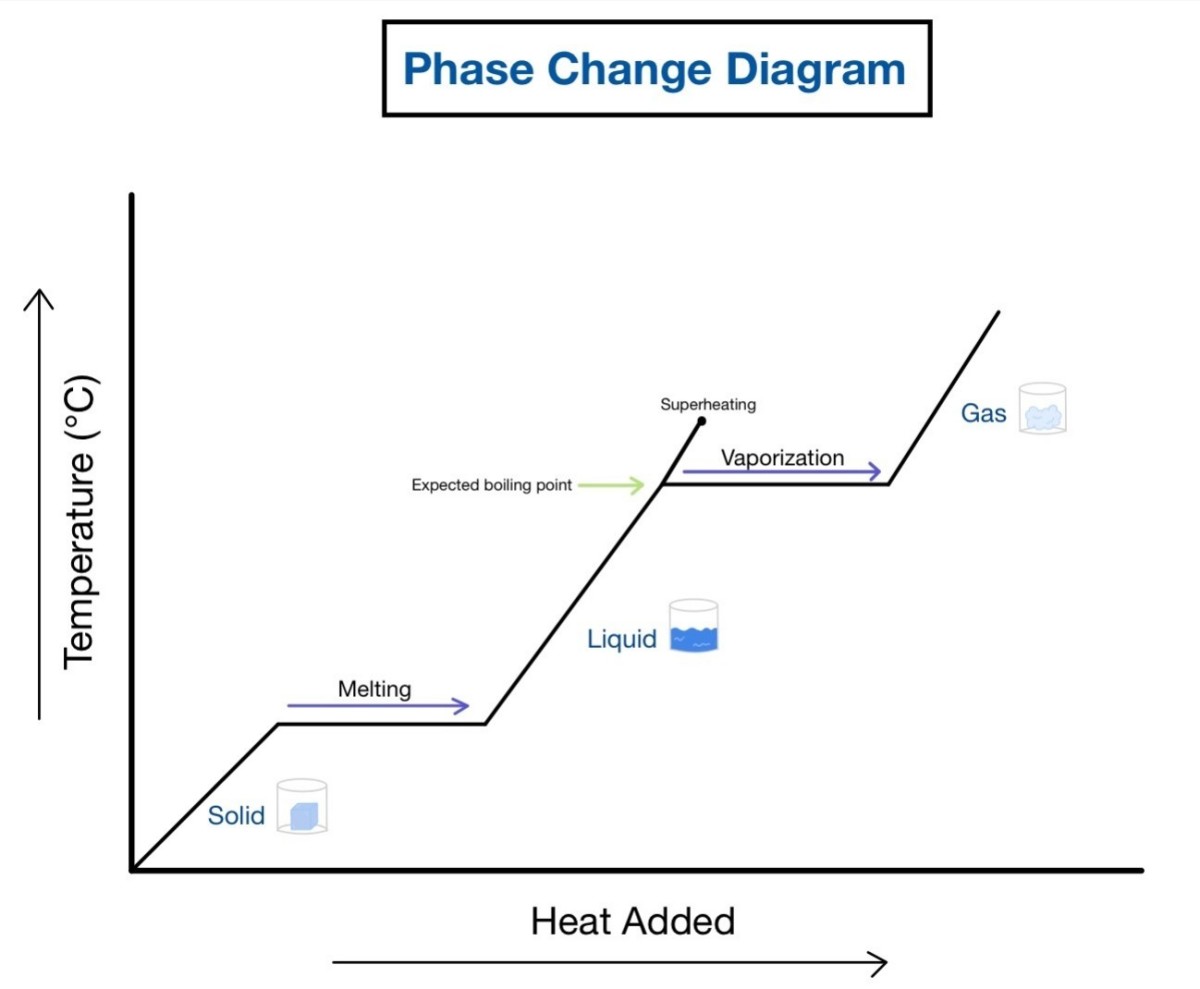
The graph below is the heating curve and was drawn by plotting the temperature of water against heat, as water was heated steadily from −15 °C to 110 °C. You could see from the curve that changes of state have taken place.
In the below graph when the temperature was first measured only ice was present. After a short time the curve begins to flatten, showing that even though heat energy is being put in it, the temperature remains constant.
Heating Curve
Particles in ice of water are known to be close to each other and are attracted to one another. For the ice to melt, their particles need to obtain sufficient energy to overcome the forces of attraction between the water particles to allow relative movement to take place. This is where the heat energy is going in the above graph.
When all the ice have melted, the temperature will begin to rise again. Generally, the heating curve for a pure solid always stops rising at its melting point and gives rise to a sharp melting point. A melting point indicates a pure sample. The addition or presence of impurities lowers the melting point.
Useful Definitions
Absolute Zero
This is the theoretical temperature (which can never be reached) at which all particle motion stops. Absolute zero is -273°C or 0 Kelvin. For us to calculate it, we use this simple equation, which is, Kelvin = °C + 273. A 1K change equals a 1°C change.
Brownian Motion
This is the random motion of particles which is caused by smaller and faster moving water particles which are constantly colliding with them and moving them around. It should be noted that an observation of Brownian motion proves the correctness of the kinetic particle theory.
Diffusion
This is the process in which particles mix or spread by colliding randomly with each other, and bouncing off in all directions. Particles travel in random zigzag motions, this is how smells spread, solid dissolves, dust particles travel in a random way when suspended in air. All gases diffuse to fill the space available.

Diffusion
Evidence for diffusion
One of the evidences of diffusion is seen in a liquid potassium manganate (VII) which has been put in a beaker of water above. In the beaker above the colour of potassium manganate will spread as a result of Brownian/random motion.
Similarly, in gases: a gas jar of air and a gas jar of bromine in the figure above are connected, the bromine travels up the tube.
Factors that Affect the Rate of Diffusion
The following are some of the factors which affect the rate of diffusion.
Temperature increase
In particles the rate of diffusion increases with an increase in temperature. Similarly, when the temperature falls, the rate of temperature decreases.
2. Particle mass decrease
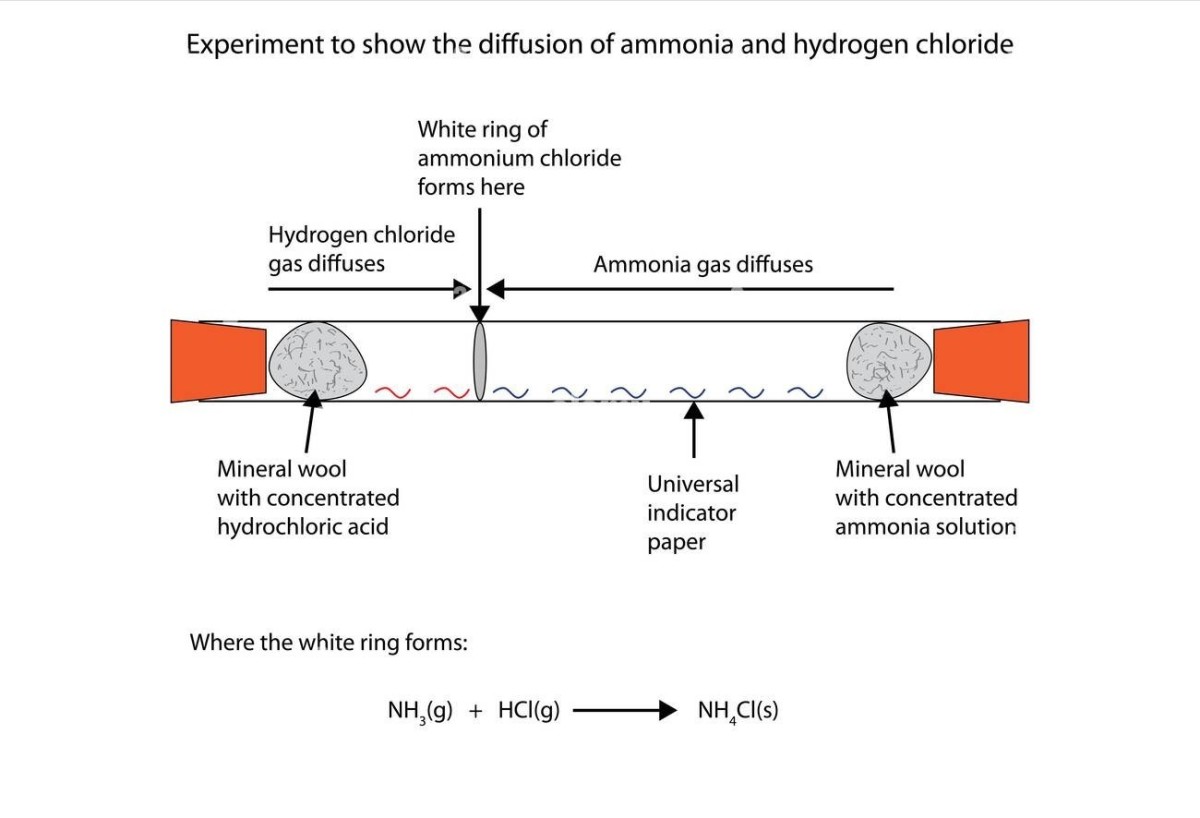
In particles the rate of diffusion increases when the mass decreases and vice versa (this is shown by the following experiment):
Evidence of Diffusion
From the figure above the NH3 molecules have less mass than the HCl molecule, so they diffuse faster, hence the product (a white cloud of NH4Cl) forms closer to the end where the HCl is.
Innovating Healthcare: Technology’s Influence on Chronic Disease Management

Innovating Healthcare: Technology’s Influence on Chronic Disease Management
Chronic diseases affect millions of people worldwide, impacting their quality of life and requiring ongoing management. As healthcare evolves, technology emerges as a powerful ally in this battle. From wearable devices to telehealth solutions, innovations are reshaping how patients and providers approach chronic disease management.
Imagine checking your blood sugar levels with a simple app or having a virtual consultation with your doctor from the comfort of your home. These scenarios are no longer just dreams; they’re becoming reality thanks to technological advancements. With every innovation comes new opportunities and challenges that redefine traditional methods.
Let's explore how technology is revolutionizing chronic disease management and what it means for patients, caregivers, and healthcare professionals alike.
Understanding Chronic Disease Management
Chronic disease management involves a comprehensive approach to treating long-term health conditions. These diseases, such as diabetes, heart disease, and asthma, require ongoing attention and care.
Effective management includes regular monitoring of symptoms and medications. Patients often work closely with healthcare teams to create personalized treatment plans that fit their lifestyles.
Education plays a vital role in this process. Understanding the nature of their condition empowers patients to make informed decisions about their health.
Lifestyle choices—like diet and exercise—are key components as well. Small changes can lead to significant improvements in overall wellbeing.
Collaboration between patients and providers fosters better outcomes. Communication is essential for adjusting treatments based on individual progress or challenges faced along the way.
In this dynamic landscape, technology has become a game changer, enhancing how these interactions occur and making management more efficient than ever before.
The Impact of Technology on Healthcare
Technology has reshaped the landscape of healthcare in remarkable ways. From electronic health records to telemedicine, innovations have improved efficiency and accessibility.
Patients can now access their medical information at any time. This empowers them to take charge of their health journeys. They no longer rely solely on hospital visits for updates or consultations.
Telehealth services bridge geographical gaps, connecting patients with specialists regardless of location. Rural communities particularly benefit from this advantage, gaining access to expert care without long travels.
Wearable devices monitor vital signs in real-time, alerting users and healthcare providers about potential issues before they escalate. These proactive measures enhance preventive care significantly.
Moreover, data analytics drives personalized medicine forward. By analyzing patient data trends, physicians tailor treatments that suit individual needs better than ever before.
As technology continues to evolve, its integration into healthcare shows no signs of slowing down.
Examples of Technological Innovations in Chronic Disease Management
Technological innovations are transforming chronic disease management in remarkable ways. Wearable devices, such as smartwatches and fitness trackers, empower patients to monitor their health metrics in real-time. Heart rate, activity levels, and even sleep patterns can now be tracked effortlessly.
Telehealth services have also gained momentum. Patients can consult with healthcare providers from the comfort of their homes. This not only saves time but fosters consistent communication between doctor and patient.
Mobile health applications play a crucial role too. These apps provide medication reminders and educational resources tailored to specific conditions like diabetes or hypertension.
Artificial intelligence is making strides in predicting flare-ups for chronic illnesses through data analysis. By identifying patterns, it enables proactive interventions that improve quality of life.
Robotic-assisted surgeries are revolutionizing treatment options by offering precision that reduces recovery times and hospital stays. Each innovation brings new hope for better management of chronic diseases.
Pros and Cons of Using Technology in Healthcare
Technology in healthcare offers numerous advantages. It enhances patient monitoring through wearable devices that track vital signs in real-time. This allows for timely interventions, improving overall health outcomes.
On the flip side, there are concerns about data privacy. With vast amounts of personal information being collected, patients worry about who has access to their health data and how it's used.
Additionally, not all technology is user-friendly. Some older adults may struggle with complex apps or devices designed for chronic disease management. This can lead to frustration and decreased adherence to treatment plans.
Moreover, while tech can improve efficiency, it sometimes creates a lack of personal interaction between patients and providers. Many people value face-to-face conversations during consultations rather than relying solely on digital communication.
Balancing these pros and cons is essential as we navigate the future landscape of healthcare innovation.
Patient Perspectives on Technology-Assisted Chronic Disease Management
Patients often have mixed feelings about technology in managing chronic diseases. For some, the convenience of mobile apps and wearables simplifies their daily routines. They appreciate real-time data that empowers them to track their health more effectively.
Others express concerns over privacy and data security. The fear of personal information being mishandled can overshadow the benefits of digital tools.
Moreover, not every patient finds technology intuitive or easy to use. Older adults may struggle with new devices, feeling overwhelmed rather than supported.
Despite these challenges, many patients enjoy connecting with healthcare providers through telehealth options. Virtual appointments save time and reduce travel stress while ensuring they receive necessary care.
Feedback from patients is crucial for developing user-friendly technologies that enhance care without adding complexity or anxiety to their lives.
Challenges and Limitations of Implementing Technology in Healthcare
Implementing technology in healthcare isn’t without its hurdles. One significant challenge is the integration of new systems with existing infrastructure. Many facilities still rely on outdated technology, making it difficult to adopt innovative solutions seamlessly.
Data security poses another concern. With increased reliance on digital platforms, protecting sensitive patient information becomes crucial. Cybersecurity threats can jeopardize trust and compliance.
Cost is a substantial barrier as well. While some technologies can reduce expenses long-term, initial investments often strain budgets—especially for smaller practices.
Moreover, there’s resistance from both staff and patients. Some healthcare providers may be hesitant to adapt to new tools or workflows, while certain patients might feel overwhelmed by technological changes in their care regimen.
Regulatory complexities add layers of difficulty when introducing new tech solutions into established protocols and guidelines within the healthcare system.
Future Possibilities for Technology-Based Chronic Disease Management
The future of technology in chronic disease management is brimming with potential. Innovations like AI-driven analytics can predict patient flare-ups before they occur. This proactive approach could change the game for many patients.
Wearable devices are evolving too, becoming more accurate and user-friendly. Imagine real-time health monitoring that alerts healthcare providers instantly when something goes awry.
Telehealth platforms will likely expand their capabilities further, offering virtual reality consultations or immersive therapies. Patients might engage in guided sessions from the comfort of their homes.
Personalized medicine could take center stage as genetic profiling becomes more accessible. Treatments tailored to individual needs could lead to better outcomes and fewer side effects.
With advancements in data security, patient privacy concerns may diminish, leading to greater trust in digital solutions. The landscape is vibrant with possibilities that promise improved quality of life for those managing chronic diseases.
Conclusion
The transformation of chronic disease management through technology is truly remarkable. As healthcare continues to evolve, the integration of innovative solutions offers new hope for patients and providers alike.
Digital health tools have empowered individuals with real-time data and personalized care plans that enhance their ability to manage conditions effectively. From wearable devices tracking vital signs to telehealth consultations bridging gaps in access, the landscape is changing rapidly.
Yet, it’s essential to acknowledge the challenges we face on this journey. Issues such as data security, patient privacy concerns, and unequal access can hinder progress. It will take collaboration among tech developers, healthcare professionals, and policymakers to overcome these hurdles.
As we look ahead, possibilities abound for further advancements in technology-based chronic disease management. Continued innovation holds the potential not only to improve individual outcomes but also to reshape healthcare systems globally.
Navigating this exciting terrain requires a balanced approach that weighs benefits against risks. The future promises a more integrated form of care where technology plays an indispensable role in enhancing quality of life for those living with chronic diseases.
How to Get Rid of Belly Fat

How to Get Rid of Belly Fat
Belly fat is a common problem that many people face today. It not only affects your physical appearance but also puts you at risk for serious health issues like heart disease and diabetes. While getting rid of belly fat may seem daunting, it's definitely achievable with the right approach! In this article, we'll discuss the main causes of belly fat and provide you with effective strategies to get rid of it, from diet and exercise to supplements and surgery. So let's dive in and say goodbye to stubborn belly fat once and for all!
Causes of Belly Fat
Belly fat is the accumulation of excess fat around your midsection, and it can be caused by a variety of factors. One major cause of belly fat is a poor diet consisting of high-calorie, processed foods that are low in nutrients. Consuming too much sugar or refined carbohydrates like pasta and white bread can also contribute to belly fat.
Another common cause of belly fat is a sedentary lifestyle with little physical activity. Sitting for extended periods may lead to weight gain as it slows down metabolism and reduces muscle mass.
Your hormones can also play a role in the development of belly fat, particularly the stress hormone cortisol which increases appetite and triggers the storage of abdominal fat.
Age also plays a part - as you get older, your body loses muscle mass which slows down metabolism leading to an increase in body weight including belly fats.
Genetics play some role since studies have shown that people with certain genes tend to accumulate more belly fats compared to others who don't have those same genes. In other words, there are several causes underlying stubborn belly fats making it important for anyone struggling should take note on their daily habits from diet choices up until physical activities.
Diet and Exercise to Get Rid of Belly Fat
When it comes to getting rid of belly fat, diet and exercise are the most effective ways. Reducing calories and incorporating physical activity into your daily routine can help you lose weight all over your body, including your belly.
To start, focus on eating a healthy and balanced diet that is low in processed foods, added sugars, and saturated fats. Instead, opt for whole foods like fruits and vegetables, lean protein sources like chicken or fish, nuts and seeds for healthy fats.
In addition to improving your diet quality, regular exercise is key in reducing belly fat. Aim for at least 30 minutes of moderate-intensity aerobic activity every day such as jogging or brisk walking. Strength training exercises such as planks may also be beneficial in toning abdominal muscles.
It's important to remember that consistency is key when it comes to losing belly fat through diet and exercise. It takes time to see results so don't get discouraged if progress seems slow at first. With patience and dedication towards a healthier lifestyle overall will lead you towards amazing results!
Supplements to Get Rid of Belly Fat
Supplements can be a helpful addition to your diet and exercise routine when trying to get rid of belly fat. However, it's important to note that supplements alone won't magically make your belly fat disappear. They should be used in conjunction with a healthy diet and regular exercise.
One popular supplement for targeting belly fat is green tea extract. Green tea contains antioxidants called catechins, which have been shown to increase metabolism and decrease body fat, including abdominal fat.
Another supplement option is conjugated linoleic acid (CLA). CLA is a type of fatty acid that has been found to reduce body fat mass while increasing lean muscle mass. It works by inhibiting the enzymes responsible for storing excess calories as body fat.
Probiotics are also gaining popularity as a weight loss supplement. These live bacteria cultures can improve gut health, which may help regulate inflammation and reduce the risk of obesity-related illnesses like metabolic syndrome.
Before adding any supplements to your regimen, it's important to talk with your healthcare provider about potential interactions with medications or underlying health conditions. And remember, supplements should never replace a balanced diet and regular physical activity when it comes to achieving long-term weight loss goals.
Surgery to Get Rid of Belly Fat
Surgery is considered as the last resort to get rid of belly fat. This option should only be considered after all other methods have failed. There are different types of surgeries available, such as liposuction and tummy tuck.
Liposuction involves the removal of excess fat from specific areas of the body using a suction device. It's an outpatient procedure that usually takes a few hours to complete. However, it comes with potential risks and complications that include infections, blood clots, and organ damage.
Tummy tuck surgery involves removing excess skin and fat from the abdominal area while tightening the muscles in that region. The procedure can take up to five hours depending on how much work needs to be done.
While these options may sound appealing for quick results in getting rid of stubborn belly fat, it's important to note that they come with their own set of risks and challenges. Recovery time can also vary depending on each individual case.
It's essential to consult with a qualified surgeon before deciding on any surgical procedures for belly fat reduction. They will evaluate your health status and suggest whether or not surgery is suitable for you based on your medical history and current condition.
In conclusion, getting rid of belly fat takes time, effort, and discipline. It's a process that requires you to make lifestyle changes such as adopting a healthy diet and exercise routine. You can also consider taking supplements or undergoing surgery to help accelerate the process.
However, it's important to remember that there is no magic solution to lose belly fat overnight. The key is consistency and persistence in your efforts. With the right mindset, dedication, and support from loved ones or professionals such as personal trainers or nutritionists, you can achieve your goal of getting rid of belly fat.
Remember that losing belly fat not only improves your physical appearance but also promotes better health by reducing the risk of chronic diseases such as diabetes and heart disease.
Start small with simple changes in your daily routine like taking a walk after dinner or swapping high-calorie snacks for fruits and veggies. Over time these small steps will lead up to big results. So don't give up! Keep pushing yourself towards achieving a healthier version of yourself – both inside and out!
10 Healthy Foods to Gain Weight Fast

Foods to Eat to Gain Weight fast
10 Healthy Foods to Gain Weight Fast
There are some foods which help us to gain weight in a fast healthy safe way if we include them in our daily diet. Eating a breakfast or a lunch is important, but the type of meal we eat matters most, as some could encourage your body to gain weight quickly unlike the other food types.
Different people respond differently to different types of meal which we take everyday, and also different people have different caloric needs. For this reason, you should consider meeting a dietician to determine what's right for your body, activity level, and goals.
This article will take a look at 10 healthy food options that you must consider taking for weight gain fast.
10 Healthy Foods to Gain Weight Fast
The following are considered the 10 foods which you should take for you to gain weight faster.
1. Milk
Studies have shown taking milk could help you gain muscle mass. Individuals tend to gain muscle mass when they drink milk in combination with weight training. Taking milk plays an important role in muscle growth as it contains the perfect balance of nutrition to support muscle growth and replenish depleted glycogen stores after intense exercise.
2. Rice
Rice contains high amount of carbs and calories, which could help you gain weight even from a single serving. Have it with your favourite dal or mix it with mangoes for a sticky rice dish. Rice could also be stir it up with finely chopped veggies like carrots, cabbage and onions, and this will put you on higher chances for gaining weight fast.
3. Peanut butter
All nuts and nut butter are rich in calorie-dense and are the perfect choices for you to gain weight fast. Peanut butter can be added to bread as a complement or be added to porridge or snacks and this will increase the amount of calories in your body which could accelerate your body in gaining weight.
4. Dark chocolate
Dark chocolate plays an important role in our body as it helps reduce the risk of heart disease, inflammation, some cancers, stress, and type 2 diabetes while keeping our spirits up and this could have a direct relationship with gaining weight as a body which is physically strong and healthy, tends to have higher chances of gaining weight easily.
5. Full fat yogurt
Full-fat Greek yoghurt is another healthy and convenient snack which gives your body higher potential for gaining weight. It has a great nutritional profile, including a well-balanced mix of protein, carbs, and fat, which helps your body to gain weight faster.
6. Red meat
All meats that are red when raw are defined as red meats and are very important as they contains both protein and fat, which promote weight gain. Steak meat contains both leucine and creatine, nutrients that play a significant role in boosting muscle mass.
7. Dried fruits
Dried fruits are known to be rich in nutrients and calories, which accelerate body for it to gain weight. All the different types of dried fruit available, they all have naturally high sugar content which speeds up weight gain.
8. Avocados
Avocados are high in vitamins, minerals, and various beneficial plant compounds, which makes them a great choice for you to gain weight. They are full of healthy fats and nutrients which gives your body higher chances of gaining weight fast. Most people enjoy avocado in the form of avocado toast.
9. Pasta
Pasta can provide a calorically dense and carbohydrate-rich path to healthy safe weight gain for you. Pasta has so many ways of cooking and serving it, which is an advantage. Make sure you avoid bleached pasta, and opt for those made with whole grains.
10. Starch rich foods
Starches helps to boost muscle growth and weight gain. They add bulk to meals and boost the number of calories consumed in our body. Starches add carbs and calories which help our body to gain weight.
In conclusion, this essay has taken a look at 10 healthy foods which you must consider taking for you to gain weight fast. Among others, the article has uncovered that, milks, avocados, dark chocolate and starch rich foods, are some of the healthy safe foods which you must consider taking for you to gain weight quickly.
6 Most Expensive Everyday Items

6 Most Expensive Everyday Items
Let's face it; most of us live on a budget. We try to cut costs where we can and get the most out of our money. But sometimes, there are everyday items that don't come cheap and can be quite costly. If you want to know what these items are, then you're in luck! In this article, we will explore the 6 most expensive everyday items that you may not have thought about before. From luxury food items to designer clothing, find out why these products come with such a hefty price tag and how you can get them for a more affordable rate.
Expensive Everyday Item #1
The most expensive everyday item #1 is a cup of coffee. A typical cup of coffee from a cafe can cost $3-$5, depending on the size and location. If you drink coffee every day, that can quickly add up to over $1,000 per year! Even if you make coffee at home, it still costs money for the beans or grounds, milk, and sugar. An alternative to spending so much money on coffee every day is to invest in a good quality espresso machine. This way, you can make your own espresso-based drinks at home for a fraction of the cost.
Expensive Everyday Item #2
We all know that groceries can be expensive, but there are some items that are more expensive than others. Here is a list of them:
- Eggs – A dozen eggs can cost anywhere from $2 to $6, depending on the type of eggs you buy. If you buy organic or cage-free eggs, you can expect to pay closer to $6.
- Milk – A gallon of milk typically costs around $3, but the price can vary depending on the type of milk you buy and where you live.
Expensive Everyday Item #3
While a nice purse may not be the first thing that comes to mind when you think of an expensive everyday item, designer handbags can cost upwards of $1,000. And if you're looking for a name brand like Louis Vuitton, Hermes, or Chanel, be prepared to spend even more. Even some of the less expensive brands can set you back hundreds of dollars.
Expensive Everyday Item #4
If you’re using the average amount of toilet paper, you’re spending about $1,000 per year on this necessary household item. And if you have a family, that number can quickly multiply. Of course, there are ways to save on toilet paper costs. You can opt for generic brands, which can be just as effective as the name brands. You can also try using less toilet paper or investing in a bidet attachment for your toilet.
Expensive Everyday Item #5
A lot of people might not think about it, but the average person probably spends a good chunk of change on deodorant every year. A quality stick of deodorant can cost upwards of $5, and if you go through one a month, that’s $60 a year. Not to mention, if you have to buy antiperspirant because you sweat a lot or live in a hot climate, that number goes up even further.
Expensive Everyday Item #6
Toothpaste - You might not think twice about spending a couple dollars on a tube of toothpaste, but did you know that the average person spends about $100 a year on this necessary item?
In conclusion, from the most expensive coffee to diamond-encrusted jewelry, these everyday items can be quite costly. All of them are luxury items and should be seen as investments that will last you for years. Although some may find it hard to spend so much money on a single item, others see these goods as pieces of art or status symbols in themselves, something that can help boost their own image. Whatever your reason for wanting one of these items, definitely make sure to do your research before purchasing anything!
Units of Concentration
Units of Concentration

Introduction
In this article you will learn different ways of expressing solute concentration that are commonly used. You will learn how to calculate concentration of solution expressed in Molality, Normality, Weight %, Parts per million (ppm), Mass per volume, Molality and mole fraction of a solution.
This article will provide you with knowledge which will help you to be able to solve any numerical questions in the units of concentration topic. Each unit of concentration has its numerical examples to help you able to understand numerical calculations of it.
Some numerical questions relating to units of concentration are given together with their densities and this makes some students to be unable to solve them successfully. However, by the end of this article, you will be able to solve every question relating to units of concentration.
Some questions which have been used as examples in this article, have been solved in different approaches to help you understand the concept. Units of concentration, is one of the topic which a lot of chemistry students find it difficult to understand and apply in solving different numerical questions and this makes them unable to get excellent grades.
This article is organized in different sections. The first part involves introducing you different ways of expressing concentration and the second part involves analysing each unit and solving several numerical questions to make you understand the concepts. An assessment is provided at the end of the course to test your understanding after completing this article.
Units of Concentration
The concentration of a solution is a measure of the amount of solute that is dissolved in a given quantity of solvent. There are a number of different ways of expressing solute concentration that are commonly used. Some of these are listed below.
Different Ways of Expressing Solute Concentration
- Molarity, M = moles solute/liter of solution
- Normality, N = equivalents of solute/liter of solution
- Weight %, Wt % = (mass of solute/mass of solution) x 100%
- Parts per million, ppm = (mass of solute/mass of solution) x 10^6
- Mass per volume, mg/L = mass of solute/liter of solution
- Molality, m = moles of solute/mass of solvent
- Mole fraction, χ = moles of solute/total moles
Concentrations expressed as ppm and N are less familiar to most students at this stage. Be careful not to confuse molality and Molarity. Molality is represented by a small "m" whereas Molarity is represented by upper case "M". Molality (m) is also known as "molal concentration" while Molarity is also known as "molar concentration".
Relationship Between Molality And Molarity
- Mass = Normality x volume x (RMM/ Integer)
- Normality = (mass x Integer) /(RMM x volume)
- Normality = Molarity x number of integers
Based on a simple subject of the formula above, we see that Normality is equal to Molarity multiplying it by the number of integers. Similarly, Molarity relates to Normality in that, we can divide Normality with the number of integers to get Molarity of a solution.
Numerical Examples
1. Molality
Molality is defined as the number of moles of solute dissolved in one Kilogram of solvent. As it is clear Molality involve moles. Key point to take note is that one liter of water weighs 1000 grams when density of a solution is not given, we assume that (density of water = 1.0 g/mL and 1000 mL of water is equal to one liter of water). 1000g is 1.00 kg. Numerical examples;
Numerical examples
1. Determine the molality (m) of a solution containing 42grams of glycerin, C3H5 (OH)3 in 750 grams of water?
Solution

2. How many grams of AgNO3 are needed to prepare a 0.125m solution in 250grams of water?
Solution

3. Calculate the molality of 20% w/w aqueous solution of H2SO4 (Relative atomic mass are: H=1amu, S=32amu, O=16 amu).
Solution

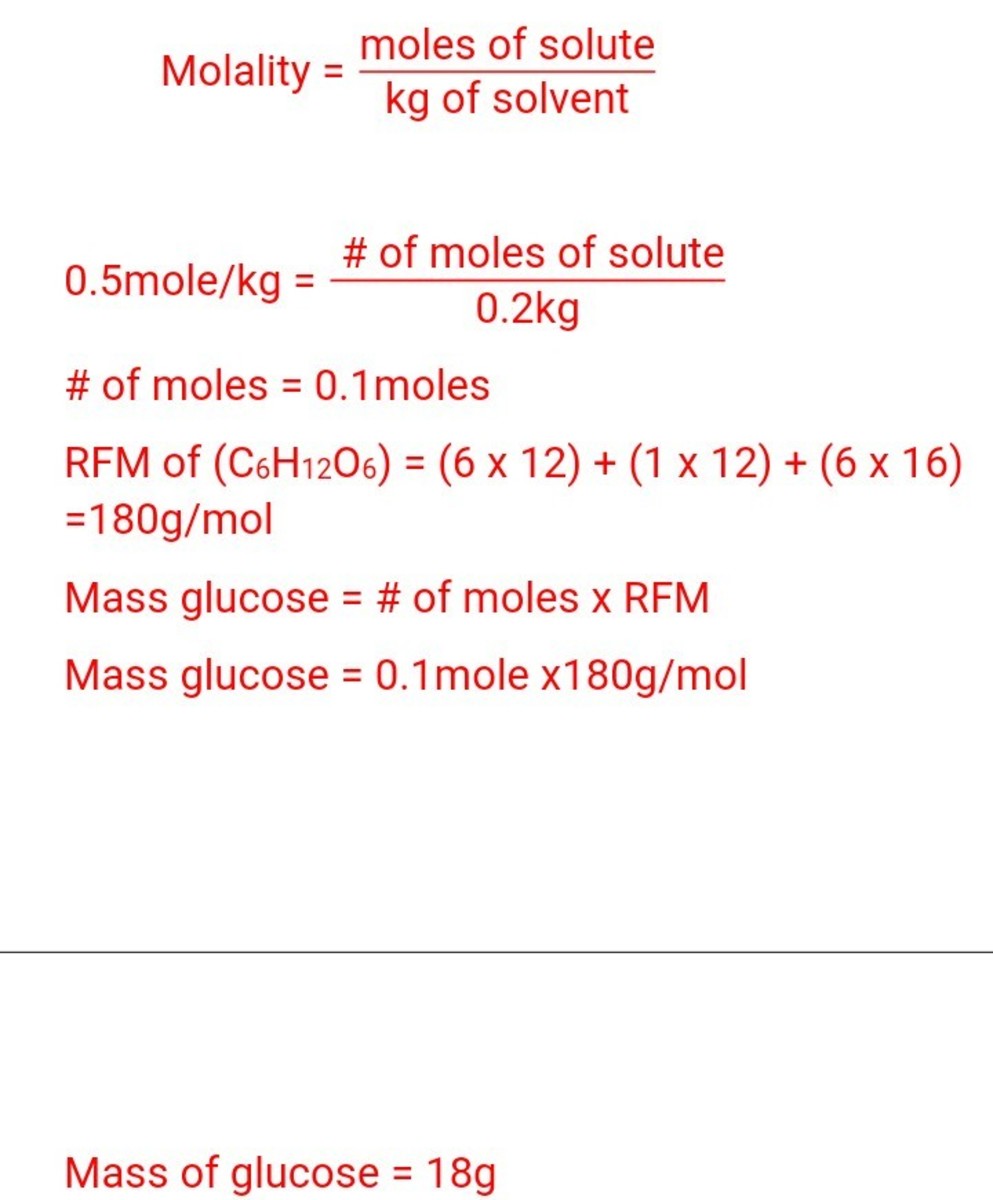
4. what mass of glucose (C6H12O6) is required to prepare 0.5m aqueous solution containing 200g of water (H2O) (atomic masses are ; C=12amu , H = 1 , O = 16amu)
Solution
2. Molarity
This is number of moles of solute dissolved in liter of solution.
Numerical examples
1. What mass of KCl is required to prepare a 100000cm3 of aqueous solution of 0.5M KCl . ( k =39.1g mol−1)
Solution

2. What is the molarity of 600. mL of potassium iodide solution that contains 5.50 moles of the solute?
Solution
M = mol solute / L soln.
M = 5.50 mol / .600 L
M = 9.16 molar
3. Household laundry bleach is a dilute aqueous solution of sodium hypochlorite (NaClO). How many moles of solute are present in 1.5L of 0.70M NaClO?
Solution
M= mol/L
0.7 = x/1.5
x= 1.05 mol_NaClO
4. What mass of K3PO4 is required to prepare 400mL solution that contains 6 x 10²¹ K3PO4 particles per liter of solution? ( atomic masses are K=39amu, P=31amu O=16amu)
Solution

5. When 25.0 mL of NaOH solution was titrated, 23.4 mL of 0.286 M H2SO4 were required to reach the end point.
a) Find the molarity of the NaOH.
b) find concentration in parts per million of sodium (Na+ )
Solution

3. Normality
This is the number of mole equivalents per liter of solution.
Numerical examples
1. Suppose you dissolved 104 g Al(OH)3 in 2000ml of solution, what would be the normality of the solution? (Relative atomic masses Al=27amu , H=1amu , O=16amu).
Solution
The problem can be solved using two methods
First approach

Second Approach
Normality = (mass x Integer) /(RMM x volume)
Normality = (104 x 3) /(78 x 2)
Normality = 2N
3. Mole Fraction
Numerical examples
1. A solution is prepared by mixing 25g of water, H2O and 25g of ethanol C2H5OH. Determine the mole fraction of each substance?
Solution


OR
We know sum of mole fraction equal to 1. So mole fraction of C2H5OH can be found by subtraction mole fraction of water from 1.
That is Mole fraction of C2H5OH= 1 – mole fraction of H2O
Mole fraction of C2H5OH= 1 − 0.71875
Mole fraction of C2H5OH=0.28125
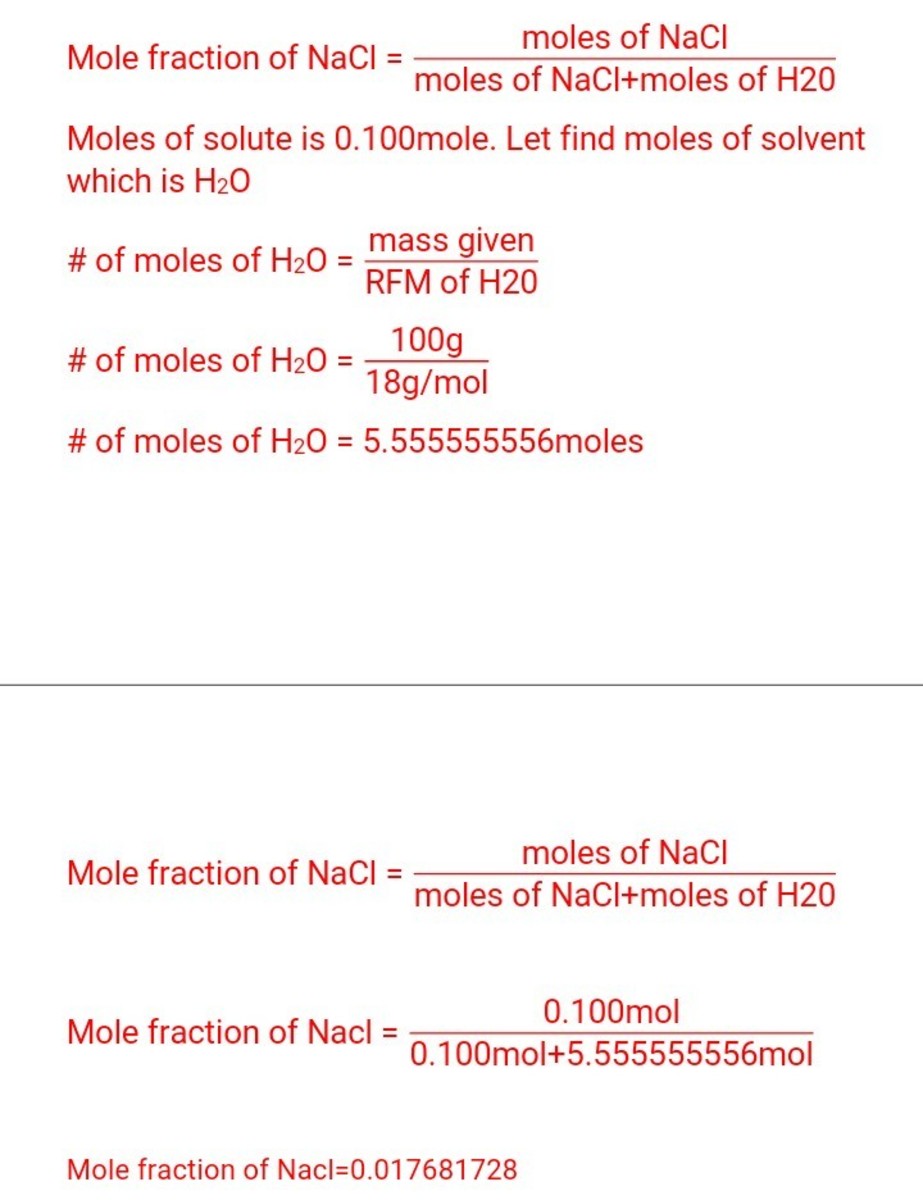
2. 0.100mole of sodium chloride [ NaCl] is dissolved into 100 grams of pure water H2O. What is the mole fraction of sodium chloride [ NaCl]?
Solution
3. How many grams of water must be used to dissolve 100grams of sucrose (C12H22O11) to prepare a 0.020 mole fraction of sucrose in the solution?
Solution


4. The molality of an aqueous solution of sugar (C12H22O11) is 1.62m. calculate the mole fraction of sugar and water.
Solution

OR
Mole fraction of H2O + Mole fraction of C12H22O11= 1
0.971666213 + Mole fraction of C12H22O11 = 1
Mole fraction of C12H22O11 = 1 − 0.971666213
Mole fraction of C12H22O11 = 0.028333787
5. Parts Per Million (ppm)
Parts per million (ppm) is the number of units of mass of a contaminant per million units of total mass. The number of milligrams of solute per kg of solution = one ppm.
Numerical examples
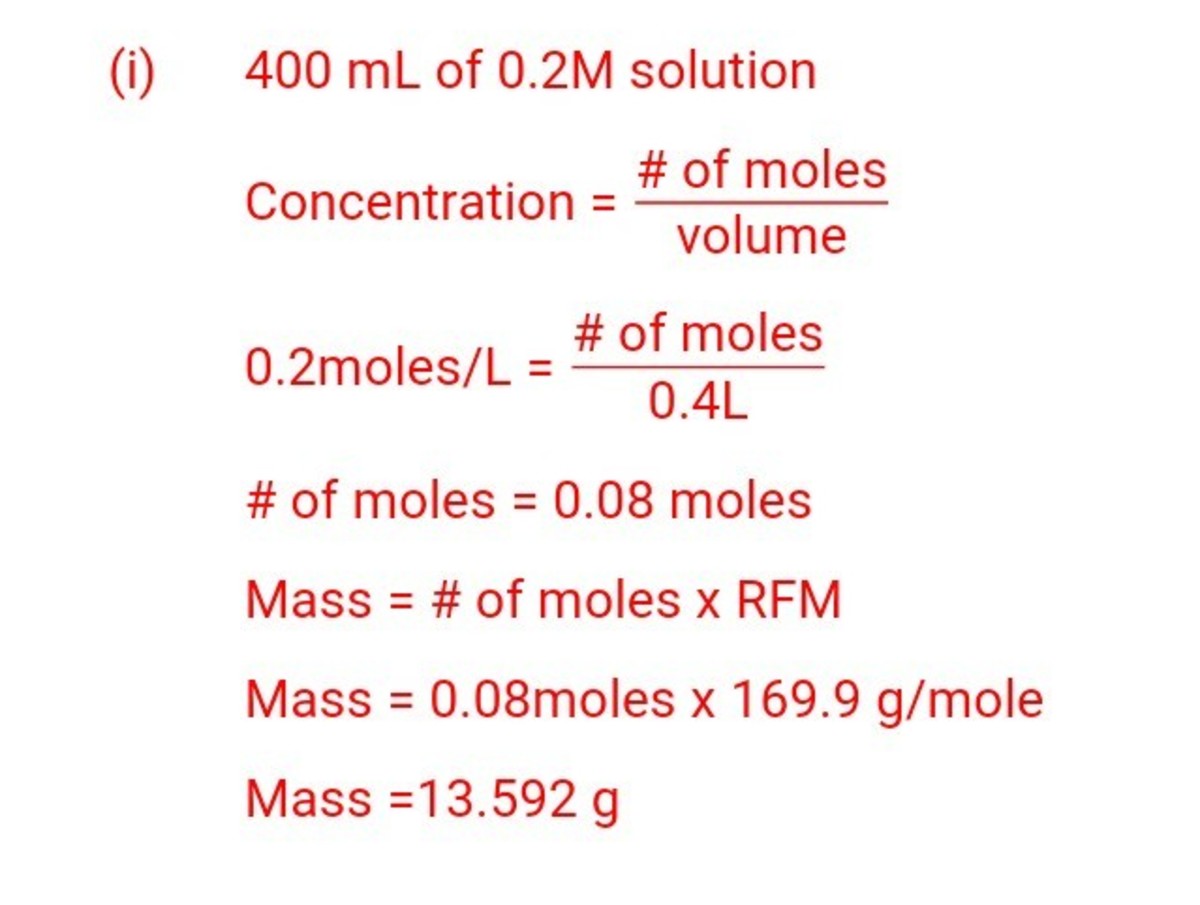
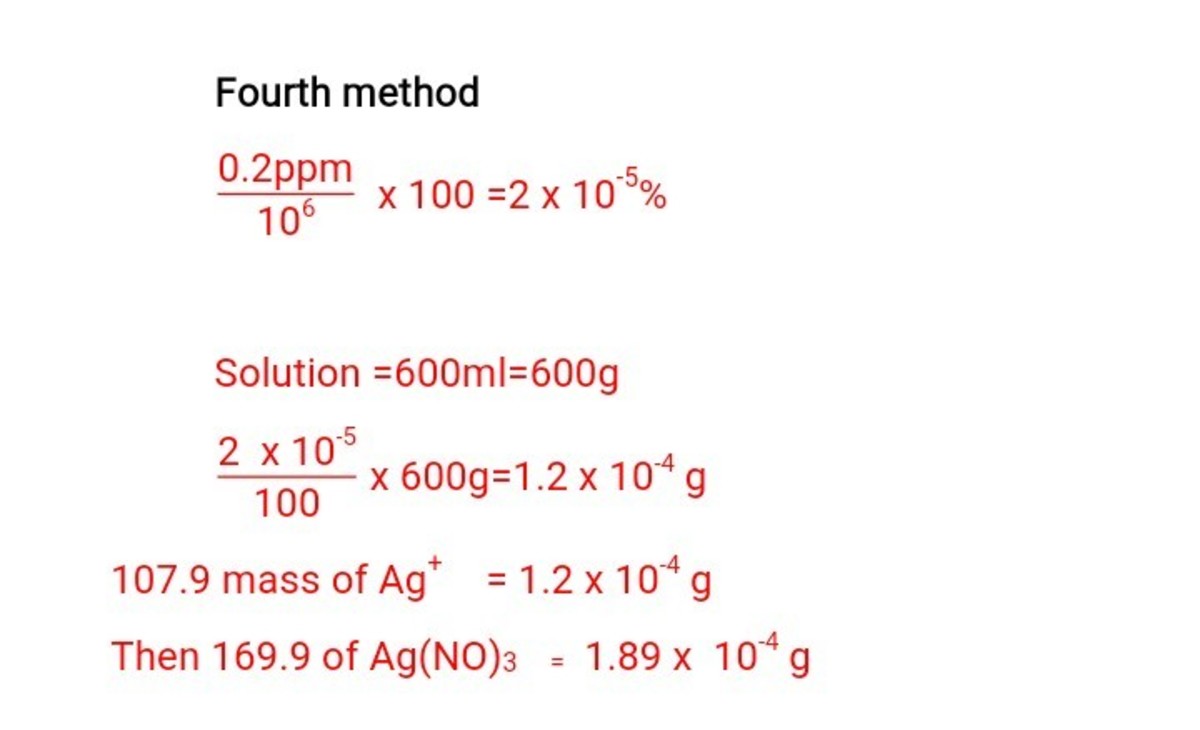
1. What weight of silver nitrate (AgNO3) is required to prepare:
(i) 400 mL of 0.2M solution
(ii) 600 mL 0.2 parts per million Ag+?
Solution

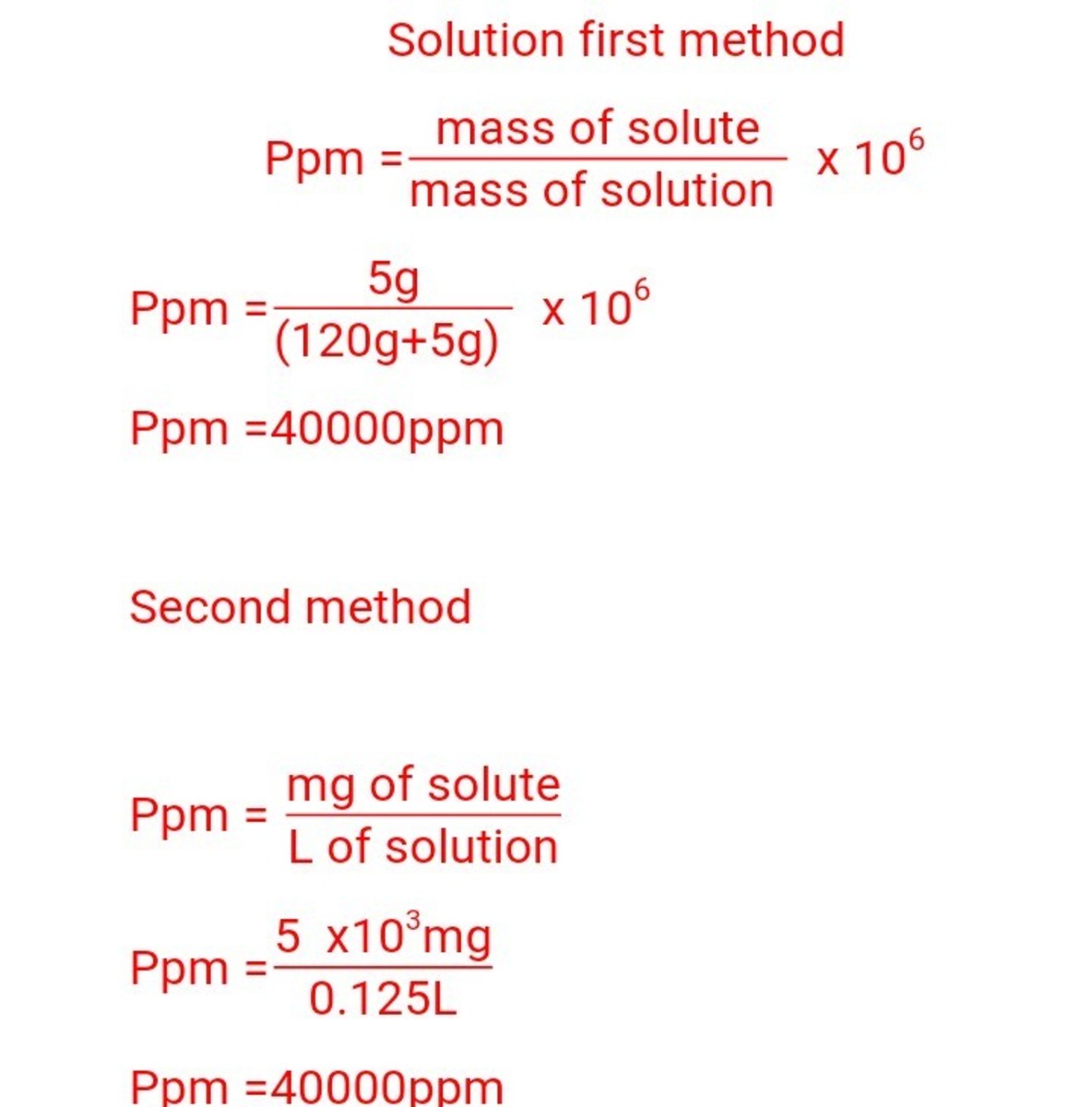
2. What is the concentration in parts per million of sulfur atoms if 120g of H2O is mixed with 5g of sulfur?
Solution
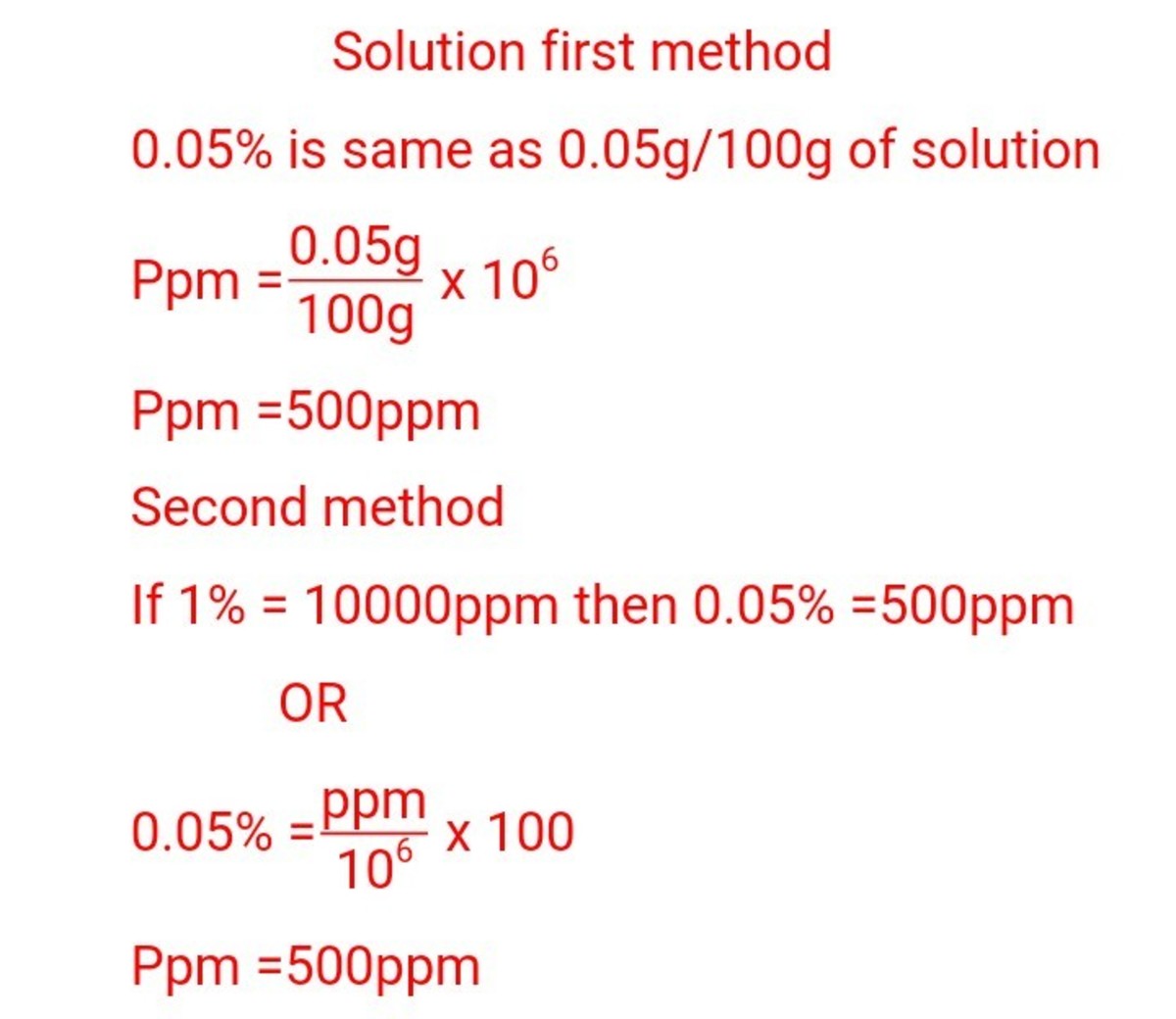
3. A sample of NaCl was analyzed and found to contain concentration of 0.05%. What is the concentration of Nacl in parts per million?
Solution
4. 8g of Al2(SO4)3 is dissolved in 180 ml of water. Calculate the concentration of Al+3 in ppm.
Solution

Mass percentage
Numerical examples
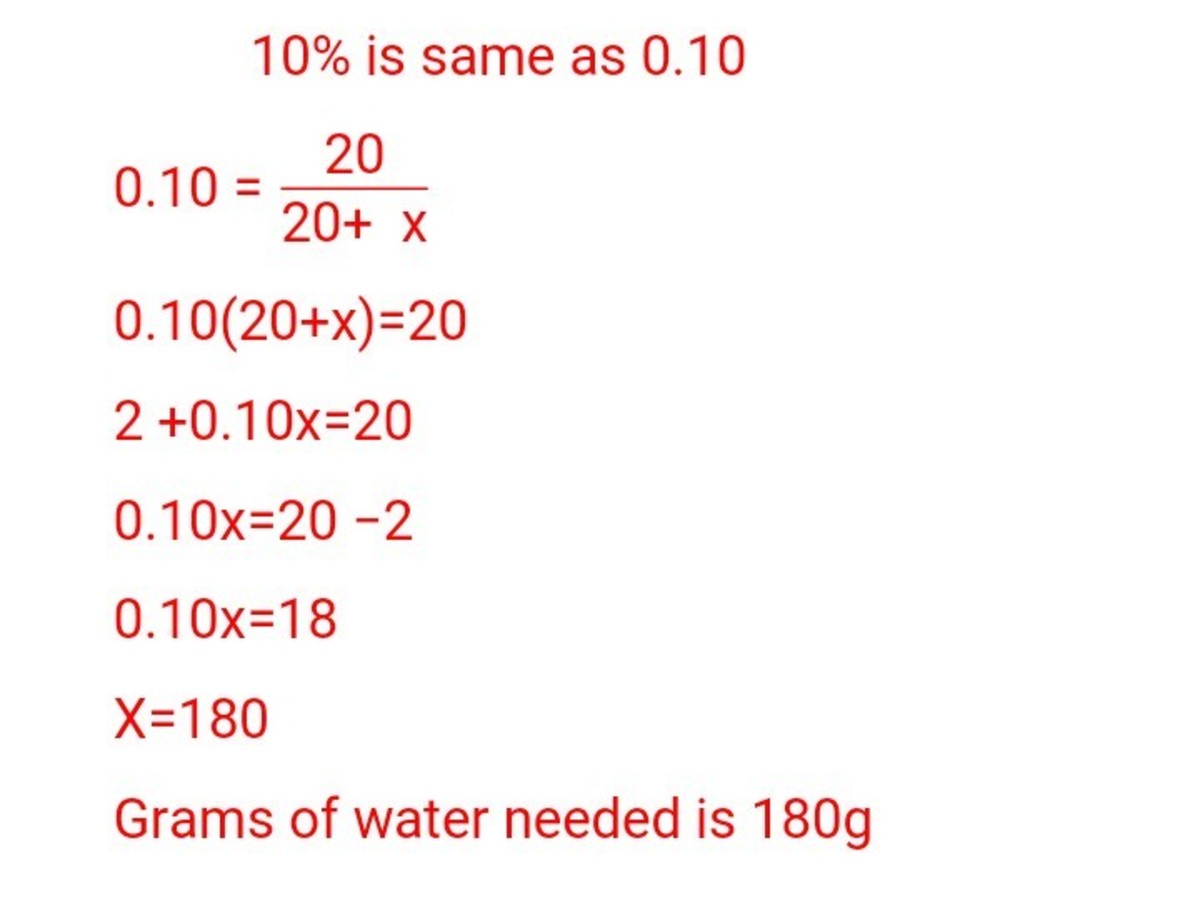
1. How many grams of water is needed to make a 10% of salt solution of NaCl if 20g of NaCl is to be completely dissolved?
Solution
2. What mass of H2SO4 is contained in 25g of 15% w/w solution? (Relative atomic mass are H=1amu , S=32amu, O=16amu)
Solution

Homemade Glycerin: Complete Step-by-Step Guide to Making Glycerin at Home

Introduction to Homemade Glycerin Production
Glycerin, also known as glycerol, is a clear, odorless, and slightly sweet liquid that is widely used in many industries such as cosmetics, pharmaceuticals, food processing, and soap manufacturing. Because of its moisturizing properties, glycerin is commonly found in products like lotions, creams, soaps, shampoos, and skincare products.
In recent years, many people—especially in developing countries—have become interested in learning practical skills that can help them reduce household expenses and create small sources of income. One of the most popular approaches is local manufacturing, where individuals produce simple products at home using affordable materials.
Local manufacturing allows people to produce items such as:
- Soap
- Peanut butter
- Cooking oil
- Juice
- Cosmetics
- Glycerin
These products can be used for home consumption or sold in local markets to generate income.
Homemade glycerin production is particularly attractive because the materials required are often cheap and readily available, and the process does not require expensive industrial equipment. With proper knowledge and careful preparation, individuals can successfully produce glycerin at home for personal use or small-scale business purposes.
Glycerin has several important uses, including:
- Moisturizing the skin
- Improving the texture of cosmetics
- Acting as a solvent in pharmaceutical products
- Serving as a humectant that retains moisture
This article provides a detailed step-by-step guide on how to make glycerin locally at home using simple materials. It explains the required ingredients, measurements, mixing process, and packaging methods.
By the end of this guide, you will understand how glycerin can be produced locally and how this knowledge can potentially help you start a small home-based manufacturing business.
Understanding What Glycerin Is
Before learning how to manufacture glycerin locally, it is important to understand what glycerin is and why it is widely used.
What Is Glycerin?
Glycerin is a natural compound derived from plant oils or animal fats. It is a thick, transparent liquid that has many applications in personal care products and industrial manufacturing.
Key Characteristics of Glycerin
- Colorless liquid
- Slightly sweet taste
- Odorless
- Highly soluble in water
- Excellent moisture-retaining properties
Because of these characteristics, glycerin is widely used as a moisturizer and stabilizing agent in many consumer products.
Common Uses of Glycerin
Glycerin plays an important role in many industries due to its versatility.
Cosmetic and Skincare Products
Glycerin is used in many skincare products because it helps retain moisture in the skin.
Examples include:
- Body lotions
- Facial creams
- Liquid soaps
- Hair conditioners
Pharmaceutical Applications
In the pharmaceutical industry, glycerin is used as:
- A solvent for medicines
- An ingredient in cough syrups
- A lubricant in medical formulations
Food Industry
Food manufacturers sometimes use glycerin as a sweetener and preservative.
It helps maintain moisture in foods such as:
- Cakes
- Candies
- Baked goods
Benefits of Producing Glycerin Locally at Home
Producing glycerin locally has several advantages, especially for individuals interested in small-scale manufacturing.
Reducing Household Expenses
Buying cosmetic products that contain glycerin can be expensive. Producing glycerin at home helps reduce costs for:
- Personal skincare products
- Soap production
- Homemade cosmetics
Creating Small Business Opportunities
Local glycerin production can also become a small business opportunity.
Possible Business Opportunities
Once you learn the process, you can:
- Sell glycerin to local soap makers
- Produce cosmetic products
- Package glycerin for retail sale
- Supply small cosmetic shops
Many successful businesses begin with simple home manufacturing projects.
Developing Practical Skills
Learning local manufacturing helps individuals gain practical knowledge in areas such as:
- Small-scale production
- Product packaging
- Marketing
- Entrepreneurship
These skills can be useful for starting other small manufacturing businesses.
Materials Required to Make Glycerin at Home
Before starting the manufacturing process, it is important to gather all necessary materials.
Ingredients Needed
The main ingredients required for homemade glycerin production include:
Primary Ingredients
- Coconut oil
- Water
- Salt
Optional Ingredients
Some ingredients are optional but can improve the quality of the final product.
These include:
- White sugar
- Coloring dye
- Fragrance (optional)
Sugar can slightly improve the consistency of the mixture, although it is not always necessary.
Equipment and Tools
You will also need a few basic tools to carry out the production process.
Required Equipment
- Cooking pot
- Heat source (charcoal stove, gas stove, or electric cooker)
- Spoon or stirring rod
- Measuring cups or spoons
- Containers or bottles for storage
These tools are commonly available in most households.
Steps Required to Make Glycerin Locally at Home
The following steps explain how glycerin can be manufactured locally using simple materials and tools.
Each step must be followed carefully to ensure the final product has good quality.
Step 1: Gather the Required Materials
Preparation Before Manufacturing
The first step in producing glycerin locally is gathering all necessary materials and equipment.
Why Preparation Is Important
Preparation ensures that:
- The production process runs smoothly
- All ingredients are available
- Equipment is clean and ready for use
Proper preparation also helps maintain hygiene and product quality.
Cleaning the Equipment
Before starting production, it is important to clean all equipment.
Equipment Cleaning Steps
- Wash the pot and spoons with clean water.
- Dry the equipment properly.
- Ensure containers used for storage are clean.
Maintaining cleanliness prevents contamination of the final product.
Step 2: Use the Correct Measurements
Importance of Accurate Measurements
Using correct ingredient measurements is very important for successful glycerin production.
Incorrect measurements can lead to poor consistency or low product quality.
Recommended Measurement Ratio
The production process uses a 2:1 ratio of coconut oil to water.
Measurement Example
- 2 cups of coconut oil
- 1 cup of water
- 1 spoon of salt
- Quarter teaspoon of white sugar (optional)
These measurements ensure the mixture reacts properly during heating.
Alternative Ingredients
If coconut oil is not available, it can be substituted with palm oil.
Important Considerations
When using palm oil:
- Choose high-quality oil
- Ensure the oil is clean
- Avoid oil with strong impurities
Good-quality oil helps produce better glycerin.
Step 3: Mixing and Heating the Ingredients
Initial Mixing Process
After measuring the ingredients, the next step is mixing them together.
Mixing Procedure
- Pour 2 cups of coconut oil into the cooking pot.
- Add 1 cup of water into the pot.
- Place the pot on a heat source.
- Begin stirring the mixture slowly.
Stirring helps the ingredients combine properly.
Adding Additional Ingredients
While stirring the mixture, add the remaining ingredients.
Ingredients Added During Heating
- 1 spoon of salt
- Quarter teaspoon of sugar (optional)
These ingredients should be added gradually while stirring continuously.
Heating the Mixture
Heating helps the ingredients react and form glycerin.
Heating Duration
The mixture should be heated for approximately 10–15 minutes, depending on the quantity.
During this time:
- Continue stirring constantly
- Avoid overheating the mixture
- Ensure the mixture remains uniform
Stirring is very important to prevent separation of the ingredients.
Step 4: Cooling and Final Mixing
Cooling the Mixture
After heating the mixture for the required time, remove the pot from the heat source.
Allow the mixture to cool gradually.
Continuous Stirring
While the mixture is cooling, continue stirring it gently.
Purpose of Continuous Stirring
- Helps the ingredients mix properly
- Prevents separation of oil and water
- Improves the consistency of the final product
After some time, the mixture will begin forming a glycerin-like liquid.
Observing the Final Product
When the mixture has cooled completely, you should observe a clear or slightly thick liquid.
This indicates that glycerin has been successfully produced.
You can now test the glycerin by applying a small amount to your skin.
Alternative Method of Producing Glycerin (Saponification Process)
Glycerin can also be produced through another method known as saponification.
What Is the Saponification Process?
Saponification is the chemical reaction used in soap manufacturing.
During this process:
- Oil reacts with caustic soda
- Soap is produced as the main product
- Glycerin is produced as a by-product
Separation of Glycerin from Soap
After soap formation, glycerin can be separated from the mixture through filtration or settling methods.
However, this process requires:
- Caustic soda
- Additional safety precautions
- More technical knowledge
For beginners, the simplified local method described earlier is easier and safer.
Step 5: Packaging the Homemade Glycerin
Importance of Proper Packaging
Packaging is the final step in the glycerin production process.
Proper packaging helps:
- Protect the product
- Maintain quality
- Improve product appearance
Packaging Procedure
Follow these steps when packaging glycerin:
Storage Steps
- Pour the glycerin into clean bottles.
- Seal the bottles tightly.
- Store in a cool and dry place.
Glass bottles or plastic containers can both be used.
Labeling for Business Purposes
If you plan to sell the glycerin, proper labeling is important.
Important Label Information
Labels may include:
- Product name
- Production date
- Ingredients used
- Contact details of the producer
Proper labeling improves customer trust and product credibility.
Tips for Producing High-Quality Glycerin
To achieve the best results when producing glycerin locally, consider the following tips.
Use Quality Ingredients
Always choose clean and high-quality oils for production.
Maintain Hygiene
Clean equipment and containers help prevent contamination.
Avoid Excessive Heating
Overheating can damage the ingredients and affect product quality.
Experiment with Small Quantities First
Beginners should start with small batches before producing larger volumes.
Business Opportunities in Homemade Glycerin Production
Homemade glycerin production can become a profitable business when managed properly.
Selling Glycerin Locally
You can sell glycerin to:
- Local soap makers
- Cosmetic producers
- Small retail shops
- Beauty salons
Expanding Production
Once demand increases, you can expand production by:
- Buying larger equipment
- Improving packaging design
- Creating a unique brand name
- Marketing your product online
Small home manufacturing projects can grow into successful small industries over time.
Conclusion
Homemade glycerin production is a simple and practical process that can be carried out using basic materials and household equipment. By following the correct steps—gathering materials, measuring ingredients accurately, mixing and heating the components, cooling the mixture, and packaging the final product—individuals can successfully produce glycerin at home.
This knowledge is especially useful for people who want to reduce household expenses, produce their own skincare products, or start small home-based businesses.
Local manufacturing of products such as glycerin not only promotes self-reliance and creativity, but it can also create income-generating opportunities within communities.
With proper practice, hygiene, and quality control, homemade glycerin production can become both a useful household skill and a potential entrepreneurial venture.
How to Make Glycerin Locally: Homemade Glycerin Step by Step
Homemade Glycerin
Making Glycerin Locally at Home
Nowadays a lot of people, especially in developing countries are looking for different opportunities which could make them able to make a few dollars, which could make them able to pay home bills and other related uses. Much as this is the case, a lot of people are learning different skills in local manufacturing which makes them able to manufacture a few products locally for home use which help them lower home spendings and also at the same time creating an opportunity for them through selling. This article will uncover steps which could be used to locally manufacture Glycerin at home.
Steps Required to Make Glycerin Locally at Home
The following are some of the steps which need to be followed for you to locally manufacture Glycerin.
1. Gather required materials
The first step to locally manufacture Glycerin is to gather the required materials. For our local manufacturing to be successful, we need to have Coconut oil, water, salt, pot, heat source, white sugar, spoon, among others. These are the required materials that we will need to locally manufacture Glycerin. It must be noted that if we want to locally manufacture Glycerin through saponification process, which is the process involved to locally manufacture soap, we can include caustic soda as our other required ingredient and this process produces soap as the main product and Glycerin as by product, but our point here is not to manaufure Glycerin through saponification process.
2. Measurements
The second step to locally manufacture Glycerin is to use the right measurements. In our local manufacturing, we will use a ratio of 2:1 and this is the ratio of coconut oil to water. Which means for every 2 cups of coconut oil, we will need a single cup of water. In other words, for every 2 spoons of coconut oil, we will need a single spoon of water. For every 2 cups of coconut oil and a single cup of water, we will need a single spoon of salt, partly quarter a spoon white sugar (which is not very necessary).
3. Mixing
The third step to locally manufacture Glycerin is mixing. Under this step you need to measure 2 cups of coconut oil and put it in the pot and measure a single cup of water and add it in the pot. After a adding these two, you need to put the mixture on any heat source and start stirring , while you are still stirring, you should add a single spoon of salt in the mixture which is getting warm and you should keep on stirring and it is at this stage where you can add a little sugar which is not very necessary. You could just add quarter a teaspoon of sugar to the mixture, which is getting heated. Make sure you warm up the mixture for about 1-15 minutes depending on the volume. Make sure as well to maintain stirring to mix up the mixture.
After 1-15 minutes make sure you remove the pot and allow the mixture to cool down, while you are still stirring constantly, without getting tired. Make sure you keep on stirring till the ingredients mix up and get cooled. When the mixed ingredients get cooled you will see that the Glycerin has been locally manufactured and you can try to use it on your body.
It should be noted that coconut oil can be substituted with palm oil, but you should make sure that the quality of palm oil in terms of colour and the like, it's quick good, for the final product to be that of higher quality. It should also be taken into consideration that you could add a little dye to change the final colour of your product.
It should also be noted that, Glycerin could also be produced through saponification process, and this process produces soap as the main product and Glycerin as the byproduct, and these two can be separated through filtration method. For the saponification process to be successful, you will need caustic soda as your additional ingredient.
4. Packaging
Having completed the above steps, the last step could be packing, whereby you will need to put the locally manufactured Glycerin on bottles ready for market and home use. As an entrepreneur, you need also to be familiar with product labeling and market research, which will help you to understand potential customers.
In conclusion, this article has uncovered 4 steps, which you must consider to locally manufacture Glycerin at home, for home use and for marketing. Among others, the article has uncovered that, for you to be successful in local Glycerin manufacturing, you first need to gather the required materials, then you need to know the right measurements and know what is required during mixing.
6 Mistakes in Life

6 Life Mistakes
In life everyone is considered to born with great life expectations, which makes him or her see a smooth path in his/her life leading him/her to live a luxurious life. Even though each one of us is born with great expectations, some people struggle in their life because of certain life mistakes which they did. This article will give in details life mistakes which the majority of people make leading to a miserable life and other related consequences.
6 Mistakes in Life
The following are the mistakes which the majority of people do in their lives, which makes them unable to live a happy life and face other related consequences.
1. Failure to learn basic skills on local manufacturing
Nowadays life has changed, such that the majority of people, especially in the developing countries are facing a certain level of economic hardship and they do not have an immediate solution to end their poverty. In life, it is required to acquire basic skills which could enable us survive in least case situation and this could be learning basic skill in local manufacturing. An example here could be learning about how you could locally manufacture home soap which requires mixing up of caustic soda, coconut oil, dye, perfume and Jerry, and with this basic skills & knowledge, you could create a local opportunity within your local area, which could be a life changing strategy.
Similarly, you could acquire basic skills on local sugar manufacturing, which simply requires you to cut the sugarcane into small pieces, pealing and extracting the juice, which is later followed by heating to evaporate the water, then cooling and crushing. With this basic skill you could create a local opportunity in the least case situation.
On YouTube there are a lot of online free video courses on local manufacturing, which you can use to acquire basic knowledge. Even though there are a lot of free video lessons on local manufacturing, some people are naturally born with a mindset that they cannot be an entrepreneur such that they cannot learn anything which relates to entrepreneurship and this is a life mistake as you do not know what life could bring.
2. Relying on one source money
Some people are not risk takers and are born to get employed the rest of their lives, such that what they think of, is finding a good and start getting a monthly salary. This is a life mistake as in some situations, you could be jobless and fail to pay your home bills leading to stress and anxiety.
Similarly, some people are born entrepreneurs and all what they think of, is for them doing business only and this is a life mistake too, as in some situations, the business environment could turn worse, leading to panic about how some bills will get paid.
Always make sure you combine two of these to minimize the impact each of these could bring in life and this could give you more confidence in case of uncertainties.
3. Over expectations
In life everyone is known to have great expectations in the childhood stage unlike when he gets aged facing real life challenges. In most cases, when our parents are doing everything, including paying our school fees and bringing food on the table, we conclude that life is simple, which is not necessarily true as we do not know which tactics our parents are using to bring the food on the table.
During our tender age, when we are known to be wise in our school, we develop certain mind that we will do well in our lives which may not necessarily be a right conclusion as we have seen a lot of people who are struggling in their lives but they were once brilliant in their primary and secondary schools and this is a life mistake which is frequently committed as it brings hope and confident in a situation which is actually hopeless.
4. Failure to invest
Sometimes we are blessed with abundance money and resources which make us to forget about how life would be tomorrow and this is a life mistake as sometimes things turn worse not to your favour.
In everything, when you have the capability of reserving some, make sure you are investing the little you have and this could be in real estate or any sector of your choice and this gives you a lifetime assurance in case of uncertainties, the life could give.
5. Comparison
In life, some people tend to compare what they are going through with that of their fellow friends. They could compare what their friends have achieved with what they have managed to do. This is a life mistake as different individuals have different route and blessings.
6. Trusting the wrong people and having association with them
Sometimes we destroy our future by putting much trust on those whom we call friends, to the extent that we wish to involve them in any business which we wish to do in our life. This is a great mistake as a business partner is not the same as a friend. Friendship and businesses, are two separate things which we should be cautious with.
When we put much trust on our friends reaching the extent of letting them run all our personal businesses, we end up creating stress, as it is highly likely that 20 years cannot pass without our friends doing something wrong in our businesses and it could be difficult for us to criticize our friends since we have chosen to combine friendship with business, which do not go together.
In conclusion, this article has taken a look at 6 mistakes in life which people do in different countries, which have an impact on their future as some mistakes could make them suffer the rest of their life or could make them live a miserable life. Among others, the article has uncovered that, not willing to learn local manufacturing skills, failure to have a multiple source of funds and trusting wrong people are some of the mistakes in life which could bring us different problems.
How to Stop Worrying in Life

Ways to Stop Worrying in Life
In life, it is very difficult for a person to be very happy each and everyone day of his/her lifetime. It is normal for a person to be in a happy mood, enjoying his life in some days of his life, similarly, the person may also come across some situations where he/she develops a worrying mind due to hardship the life could give. This article will take a look at 5 ways which you should consider doing to solve a worrying problem, which may affect your personal health.
5 Ways to Stop or Reduce Worrying
The following are considered useful ways which you must consider to solve a worrying problem which has negative outcomes on your personal health.
1. Dig deep to find the root cause and have a suggested solution
The first way to stop worrying or reduce its extent is to analyze the worrying situation in what exactly is causing it and come up with a suggested solution. An example here is that, you could be worrying about lack of money and it's root cause could be that, you does not do anything viable, which could bring money on the table and a suggested solution to this could be learning basic skills on local manufacturing, which include skills on how you could manufacture home soap, sugar and peanut butter locally at home and take this as your opportunity to start a small scale business within your local area.
Similarly, if you are worrying about personal life challenges, make sure you try to find out their root cause and come up with a suggested solution.
2. Seek guidance and counselling
Sometimes our personal problems which bring worrying mind in us could be easily solved when we seek psychological support from experts and friends. This is so as sometimes things which we worry about have very simple solutions, but because we don't not know immediate answers, we tend to be in a worrying situation.
Similarly, we could also explain the situation which we are going through to our friends, who could help us in coming up with suggested solutions, which could help us reduce the level of stress in us.
In most cases, when a person is going through a lot in life, we tend to have bad health, as stress and anxiety relates to personal health as well. Which means seeking counseling help, could help us solve a lot of problems, which are affecting us everyday about our personal life.
3. Learn skills on local manufacturing and start small scale businesses
Sometimes some of our problems which brings us stress relates to finance, as we are not able to solve certain problems whose solution is money only. Even when someone brings his/her advice, the problem cannot be fixed as it only needs financial support. In this case, learning skills on local manufacturing help you minimize the level of stress which could make you worry everyday, as you could use your local manufacturing skills to create a local manufacturing which could make you able to make a few dollars a day.
You could learn skills on how you can manufacturing tablet soap at home, which simply needs mixing caustic soda, coconut oil, perfume, Jerry and dye and you can use this as your opportunity to start local manufacturing, which could help you earn a few dollars, which you can use to pay home bills reducing the level of stress which makes you worrying. As of today, there are a lot of YouTube free videos which offer skills on local manufacturing.
4. Gratitude
Sometimes we worry about things which we are better off, than our friends due to lack of gratitude. An example here, could be a student who has scored 95% in mathematics, but is worrying about not getting 100% to the extent of developing some stress, yet the majority of his friends have got below 50%. In this case, we could see that if we practice gratitude, we could easily see that, some of the things which we worry about, does not worth it.
Similarly, when it comes to having personal assets, sometimes, we could see that, we are far better than our friends yet each and everyday, we express our worry to our friends for life not being on our side yet we are far better off.
5. Relaxation
Sometimes we are stressed up because of working more than the recommended daily working time and this may affect our physical health as well as bringing stressful mind. In this case, all what needs to be done, is to calm down and relax. Take a little sleep to refresh your body and mind, and that worrying mind, would go away.
In conclusion, this article has taken a look at 5 ways, which could be used to stop you from worrying and start leaving a happy life. Among others, the article has uncovered that, feeling grateful, relaxation and learning different skills, are some of the ways which you must consider to mitigate worrying problems.
How to be a Successful Person in Life

Ways to be Successful in Life
As the world is changing, it is becoming a wish of everyone to be a successful person in life. Even though everyone has a wish of becoming successful in life, not everyone is able to make it and become a recognized person in life.
This article will take a look at 4 ways to become a successful person in life. Being a successful person has a multiple meaning as to some could mean having millions of dollars, while to some could mean having at least thousands of dollars which makes them able to pay bills.
4 Ways to Become a Successful Person in Life
The following are considered ways which can help you to become successful in life.
1. Learn skills on local manufacturing
The first step to become a successful person in life, is by acquiring knowledge on local manufacturing and taking this as an opportunity in your local area.
As of today, the most successful persons we see, if we could be interested to hear their stories, some of them are fascinating, as they could show that at one time they had gone through different challenges, but they stood film. Some stories could show that some of the most successful individuals started their businesses with small amount of capital, and they kept on investing.
Similarly, to be a successful person in life you can create a local manufacturing opportunities within your local area by learning basic skills on local manufacturing. An example here, could be learning basic skills on tablet soap local manufacturing, which involve mixing caustic soda, palm oil, water, Jerry and dye.
As of today, there are a lot of online YouTube videos which talk for free in basic skills on local soap manufacturing, which you must consider. Similarly, you could learn basic skills in local sugar manufacturing, which involves, cutting the sugarcane, peeling, pounding, squeezing to extract juice, boiling to evaporate water, then cooling and pounding (crushing).
You could also acquire basic skills in local peanut butter manufacturing, among others, and use this as your opportunity in your local area.
2. Be a real entrepreneur
Becoming a real entrepreneur is considered a way to go for you to become a recognized person in your area. You might, be wondering as to what exactly does it mean to become a real entrepreneur.
For you to be a real entrepreneur, it means you should endure any entrepreneurial challenges which you will go through in your business journey, if you opt business as a way to go.
As an entrepreneur, you need to develop a well promising business plan and get ready to face any life business challenges you might go through, without giving up and this will help you to build an entrepreneurial experience.
3. Mindset change
The third way for you to become successful in life is to have a mindset change and develop that of an entrepreneur.
Mindset change here, could mean, you must start seeing things differently, such that where people are seeing problems, you must be considering this as your opportunity and start creating possible solutions, which could solve their problems.
Through mindset change, you can start seeing that most things, which you once had considered as impossible, are then possible. The secret is to think outside the box and never to give up when you pass through any entrepreneurial challenge, you might come across.
4. Education
Getting educated is considered as another way of becoming successful in life. Education improves your thinking ability and can help you to wisely use the available opportunities within your local areas.
Through education, you can also secure a good job which can be used to generate your start up capitals for your businesses. Education helps you to understand your business much better than if would be an illiterate.
In conclusion, this article has taken a look at 4 ways, which can help you to be a successful person in life. Among others, the article has pointed that, mindset change, education and learning local manufacturing are some of the key points which you should consider.
The Dos and Don'ts of Snacking

The Dos and Don'ts of Snacking
Are you a serial snacker? Do you find yourself constantly reaching for a bag of chips or candy bar in between meals? Snacking can be a great way to curb hunger and keep your energy levels up, but it's important to do it right.
In this blog post, we'll explore the dos and don'ts of snacking so that you can make smart choices when it comes to satisfying those cravings. From healthy options to avoidable pitfalls, let's dive into the world of snacking!
What to Snack on
When it comes to snacking, choosing the right food is crucial for maintaining a healthy diet and avoiding unnecessary weight gain. Here are some ideas of what to snack on:
Fresh fruits: Fruits are packed with vitamins, antioxidants and fiber. They are also low in calories and can satisfy your sweet cravings.
Vegetables: Vegetables like carrots, cucumber, celery or bell peppers make great snacks when cut into bite-sized pieces. They are crunchy and refreshing while being low in calories.
Nuts and seeds: Nuts such as almonds, walnuts or cashews offer a satisfying crunch while providing protein and essential fatty acids. Seeds like chia seeds or pumpkin seeds can be added to yogurt for an extra nutritional boost.
Greek yogurt: Greek yogurt is high in protein which makes it a filling snack that will keep you satisfied until your next meal. You can add fresh fruit or honey for extra flavor.
Whole grain crackers: Whole grain crackers provide complex carbohydrates that will give you energy without spiking your blood sugar levels. Pair them with hummus or guacamole for a tasty treat.
By choosing these options instead of processed snacks high in sugar, salt, and unhealthy fats, you'll be able to maintain a balanced diet while keeping hunger at bay between meals.
What not to Snack on
When it comes to snacking, there are certain foods that should be avoided. These types of snacks can be high in calories, sugar, and unhealthy fats. Here are some examples of what not to snack on:
Firstly, avoid processed snacks such as chips and cookies. They tend to have a lot of added sugars and unhealthy fats that can lead to weight gain and other health issues.
Secondly, try to steer clear of sugary drinks like soda or energy drinks. These beverages are loaded with calories but provide little nutritional value.
Thirdly, watch out for snack bars that may seem healthy but actually contain a lot of added sugars and preservatives.
Fourthly, be cautious when snacking on dried fruits as they often have added sugars or sulfur dioxide which is used as a preservative.
Don't rely too heavily on pre-packaged convenience foods like frozen meals or microwavable popcorn which can contain high levels of sodium or artificial flavorings.
By avoiding these types of snacks you'll be able to make healthier choices overall and feel better about your snacking habits.
How Often to Snack
When it comes to snacking, frequency is key. Some people may think that snacking throughout the day can lead to overeating and weight gain, but this is not necessarily true. In fact, snacking can actually help regulate hunger and prevent overindulging during meal times.
The key is to choose healthy snack options and to snack in moderation. Aim for snacks that are high in protein or fiber, such as nuts or vegetables with hummus. These types of snacks will keep you feeling full for longer periods of time.
It's also important to pay attention to your body's signals and eat when you feel hungry rather than just out of boredom or habit. If you find yourself reaching for a snack too often, try drinking water first or distracting yourself with an activity before indulging.
In general, aim for 1-2 small snacks per day between meals. This will help keep your metabolism going and prevent extreme hunger that could lead to unhealthy food choices later on. Remember - snacking isn't bad as long as it's done in moderation with healthy options!
In conclusion, snacking is an enjoyable and convenient way to stay energized throughout the day. However, it's important to remember that not all snacks are created equal. By following these dos and don'ts of snacking, you can make smarter choices when reaching for a bite.
Do opt for nutrient-dense options like fruits, nuts, and veggies while avoiding sugary treats and processed foods. Do listen to your body's hunger cues and snack as needed but don't let snacking become a replacement for balanced meals.
By incorporating mindful habits into your snacking routine, you'll be able to fuel your body with the nutrients it needs to power through any task at hand.
So next time you reach for a snack, keep in mind these simple guidelines and enjoy every bite without compromising on your health goals!