Learn smarter with fresh insights from our tutors.
Practical study guides, course supplements, and learning resources curated to help you move faster through every subject.
5 Reasons Why Small Scale Businesses Fail to Make Profits

Small Scale Businesses
It is a dream of every business person to get a reasonable profit on any business which the person wants to venture into. Much as this is the case, not every expectation of a business person results into a successful opportunity.
Nowadays a lot of young and old individuals are eager to know as to which small scale business is very profitable which could see them becoming millionaires overnight.
In every business it is not each and every business idea that will result into an opportunity as some ideas are just mere ones not viable enough to venture into.
This article will take a look at 5 reasons why some small scale businesses fail to get more profits or fails completely.
5 Reasons Why Small Scale Businesses Fail to Make Profit
1. Lack of proper market research
Market research is a research in business which aim at gathering market information on which products on the market are being liked by the consumers and how consumers want the products or services in offer to be improved.
This is not all as it also involves gathering information on various problems and complaints that the consumers or buyers are facing. Through this market research an opportunity is easily discovered, business customers' problems are easily addressed resulting in happy customers.
Now the big question which we could ask or have in mind is, why a lot of small scale businesses unable to do market research? Some of the possible reasons are lack of funding, lack of knowledge on how a market research is conducted among others.
2. Lack of business plan

A business plan is a road map that guides every business resulting in easy implementations and focus on the business.
The business plan comprises the business description which gives more details as to which business will be conducted, where the business will be conducted, who will be running the business, where will the business get registered, what is the business be doing and what does it expects among others.
The business plan also shows projected cash flows over a period of time and how the critical risks will be addressed. This is not all as it also shows overall cost and statements of profits or losses as well as sales forecasts over a certain period of time.
However, most of small scale businesses are unable to have a well written business plan which acts as a guide in their business. With the coming in of an online learning material, different individuals are now able to write the business plan themselves with simple easy to use guide.
3. Lack of enough funding
Most of small scale businesses lack enough funding, which acts as a strong capital base. This is much the case as most of small scale business owners are unable to get the loans to pursue their dream businesses due to lack of collaterals as most of loan lenders requires certain conditions be achieved, which among others include collaterals which acts as surety for loan repayments as well as in case of defaults or incapacitation.
4. Copying of business ideas or using already used or written business plan
Copying of business idea is becoming a greater challenge to new individuals in the business because what works for John does not necessarily means it will work for Mark and what works in one area does not necessarily means it will work in another area.
Similarly, using already written business plan is a problem because the business idea to business plan does not necessarily means it will work in your area or country bringing same projected profits since the competitor's analysis differs depending on locations.
5. I will do it alone mindset
Most of small business owners do not necessarily want to involve others in business, this might be the case as they do not want to share the profits or business returns. This results into a problem as knowledge sharing and implementation in business is a great good to go if you want to go higher in business.
In conclusion, this article has taken a look at 5 reasons why some small scale businesses are failing to get a reasonable profit which could change their lives.
5 Steps to Become Successful in Farming Business

Agribusiness Farming
It is a dream of every person to become successful in life. Much as this is the case, not everyone becomes a successful person in life. While some becomes successful persons through wealthy inheritance, others have to discover different opportunities which could take them from being broke and poor to being most successful persons in their lives by means of farming businesses.
This article will take a look at secrets to become successful person by means of agribusiness.
Before we go further with the 5 steps, firstly let's define what agribusiness is. Agribusiness is defined as any farming, which is done for commercial purposes and is measured by how much output in farming is sold and a profit is realized.
Now let's go further in uncovering on how a person could become a millionaire in farming.
5 steps to be followed
1. Mindset change
No one on earth is born a farmer. There are a lot of reasons which influences a lot of people to venture in farming some of them are:
The Situation factor. Some persons venture in farming because they don not have any other opportunity to depend on. An example is a university graduate who has done telecommunication studies with a full hope of being in office in telecommunication industry receiving high salaries, but ending up unemployed and being forced to start farming because he/she do not have alternative ways. In most cases in this situation the person do not take farming as a very serious business resulting in inefficiencies and low profits, which after sometimes might force him/her to venture into other opportunities. The secret is that if you want to be more successful in farming, it should start with mindset change which can make you start taking farming with a full passion.
Another example which we can also share is for those individuals who get employed and later retires and wants to start farming because they are no longer supported in the employment sector and this could less likely make them taking farming as a serious business.
Being motivated to start farming after seeing our friends' success in their farming businesses. In this case a person becomes a farmer not necessarily because he/she want to take farming as a profitable business but because he/she is interested in money which he or she has seen from a friend and this results in inefficiencies due to lack of certain farming knowledge and management techniques which our friend has used.
Becoming a farmer because you have resources in farming. Some individuals become a farmer not necessarily because they want to but because they have the required materials, i.e a big piece of land which they probably inherited and they want to turn this as a serious life opportunity.
In this case it results in inefficiencies too, as a person is forcing himself or herself to become a farmer because he or she is seeing the materials available forgetting technical know how or cultivation techniques required to make more profits in agribusiness.
Becoming a farmer because you want to become a farmer. Most of the individuals in this category become the most successful in their farming businesses because they do the farming activities with all their hearts.
2. Learn more about farming

Digital Farming Agriculture
Having changed your mindset towards farming, the next step is to learn more about farming. It is known that no one knows everything so you can learn anything about farming from your local friends who are in farming businesses and you can also learn online by joining farmers online lessons in agribusiness.
You might be wondering as to where you can find free online lessons in agriculture, which can accelerate your farming knowledge, worry not as you can use free resources on YouTube to increase your knowledge in agribusiness since enough knowledge is the key in any farming activities.
3. Increase your knowledge by interacting with specialists
Online classes in farming is not the only way of learning as a means of increasing your knowledge in farming activities as you can also seek farming guidance from agribusiness managers, agricultural economists, agriculture extension officers among others. Usually these people have knowledge which they learnt in schools or colleges which could be shared resulting in you being the beneficiary.
4. Gather resources and start farming business
Having learnt or acquired enough knowledge and expertise the next step is to gather the farming resources and start your farming business and this will enable you to do the farming with a full hope which will enable you to endure any farming challenges which you might go through ending in achieving your dream goal in farming.
No one can be successful in farming if he or she does not have enough farming resources since this acts as an engine in farming activities.
5. Do proper market research to find a good buyer
Having taken the farming as a business by following the steps above, now the last step is doing a simple market research to discover buyers who will purchase your commodities at a higher prices which will maximize your profit.
In a simple term, a market research is a questionnaire which content questions which you want to acquire information. It could for example, contain questions on how much the buyer will be willing to pay for your products whenever it is available for market as well as the quality he or she might be interested on.
Through this you discover exactly as to what the buyers are willing to pay and what qualities will make them happy. In most cases the questionnaire is given to multiple buyers and all the data is connected and analyzed to have one general conclusion.
In conclusion, this agribusiness post has taken a look at 5 steps which if followed can lead you to become a millionaire within shortest farming periods.
It is known that agriculture is backbone for most economies of developing countries and this could be part of your opportunity in assisting developing the economy of your country as well or contributing in value chain management as a supplier of raw materials.
5 Ways to Start a Successful Business and Become a Millionaire

Business Secret
Some people are becoming rich, while others are becoming poor.
In an ever changing world, it is a wish of every person to be successful and enjoy a luxurious life. However, not every person become successful person in life even though people thinks in that way.
This article will take a look at 5 ways which can help you become a financially independent person in a few days to come if you will take at least one of the 5 ways seriously.
Before we take a look at the 5 ways which will likely make you a millionaire, it should be taken into consideration that, there is a need of changing your mindset first in everything.
5 Ways to Become Successful in Life
1. Develop a brilliant business idea and sell it to investors
Most investors have almost all the required materials to start the business, but not every investor is good at coming up with the best business ideas. This can act as your opportunity to develop the best business idea and sell it to investors who are looking to invest and this can act as your starting capital.
The business idea can easily be attractive if it is drafted on a business plan, which, among others, can show how the business will be able to deal with some risks through a well written business plan containing a well written SWOT analysis, as well as projected cash flows and sales focus.
2. Formulate a group and use it as a collateral to access the loan in your local country
In some countries, especially developing ones, governments and other financial institutions are able to provide medium loans to people who have financial challenges usually whose age ranges from 18 to 65. These small scale group loans are offered in different types or categories.
It could be youth loans which can be based on the age range of 18 to 35, women loans could start from 36 to 65, men loan usually ranges from 36 to 65 as well. This is not all as there could be other different loan categories. The key or secret is that you can use the group as a collateral for getting the loan and start a small scale business which can change your life and could as well turn into a big one in a few days using a few efforts.
3. Formulate a business plan and use it to get loan from financial institutions

One of the use of a business plan or one of the top most important about it is that, it can be used to get a loan from banks and other financial institutions available in your country and this can act as your starting up capital. A lot of financial institutions are willing to finance a well written business plan which has a great potential for success even with minimal collaterals as they become so sure that their money will be repaid because the best business plan shows high degrees of success.
4. Get a grant
A grant is money which is given to some people with promising business ideas but lack capital and is given with no interest in return. The grant is given with the aim of uplifting the lives of the poor who have brilliant ideas, but lacks fund. What you have to do is to take your time and effort in coming up with the best and a well promising business plan and apply for the grant from your local providers.
5. Use your phone or computer and internet
You might be wondering as how your phone or personal computer could be the source of funds to your business ideas. Well, with your phone or computer you can participate in an online blogging site where you could write anything interesting and post it in their sites. You do not need to have a website to do this as you can do this on free websites which accepts the best guest blogs or articles and monetize it for you.
Similarly, you can also produce any video on any topic which is interesting and upload it on YouTube for free and later monetize it. This is not all as there are also other sites which offers paid questions and answers forums and you could join them as an online tutor and monetize your answers in the process.
In conclusion, this article has taken a look at 5 ways how you can start from zero and becomes a well to do person since it is known that to born poor does not necessarily means you will die poor. All what you have to do is picking any of those ways above, kick start a business and become financially stable in a few coming days to come.
10 Reasons Why Africa is Poor

10 Reasons Why Africa is Poor
Poverty is a word which has multiple definitions. According to World Bank it refers to those who spent at most $3 a day. Africa is one of the continents which is considered the poorest in comparison to other continents on earth. The majority of people in Africa live below $3 a day. This article will take a look at the reasons why Africa is so poor.
10 Reasons Why Africa is Poor
The following are the main reason why Africa is so Poor:
1.Lack of Modern Technologies
Most people in the African continent are not technologically advanced because of a number of reasons such as lack of education and capital. This makes them to be far behind in the technological sector. As such, they rely on consumption instead of manufacturing, which has potential to bring foreign money through exports.
2. Poor Governance
The African continent has many valuable resources enough to be most talked continent on financial independence, however, these valuable resources are misused by those in power, who create wealth for themselves. For a long time, Africa has been governed by dictators who have exploited their countries in several ways.
As of today most African governments depend on foreign aid to support their government budget, but in most cases those in power pockets these money for themselves and nothing explains better than greedy.
In Africa corruption is almost everywhere, starting from police sector and other potential sectors have bribed governances.
3. Lack of Education
The majority of people in Africa are illiterate and those who go further with their education are full of theories, which does not work on the ground. Unlike in foreign countries whose education focuses much on practical part, in Africa, people could go to school just to be taught theories.
A few people who go to school in most cases drop it before reaching universities or colleges, this makes their thinking capacity to be slow, in comparison to similar age group in foreign countries, non African.
Lack of education makes different people to have enough materials which can make them rich, but they lack the skills to transform them.
4. Inadequate Agricultural Infrastructure
The majority of people in Africa are poor, as such they cannot afford to buy modern farming equipments to venture in Agribusiness, which is one of the weapons for transformation to African people. Africa comprises 20% of the world’s land, but only produces 4% of all vegetables and 1% of all fruit for commercial export.
5. Poor Health
The majority of people in Africa have poor physical health, which make them unable to be more productive. Poor health is accelerated due to poor feeding diet, which leave majority of them malnourished.
Different diseases spread rapidly in Africa due to lack of enough preventive measures. Diseases such as HIV and AIDS, Malaria and Tuberculosis, have claimed multiple lives in Africa. In some cases, people who die, are those with skills who could help in developing African continent.
6. Wars and Crises
In Africa some people of the same tribe fight themselves instead of uniting and working as one. In most cases there are leadership wrangles which bring internal conflicts and wars. People who do not unite, can less likely develop.
7. High Production Cost
The majority of African workers are not efficient due to lack of relevant skills and knowledge, this makes the manufacturing sector in African continent to be less competitive on an international market. This contributes to poverty.
8. Unjust Trade Structures
Another reason explaining why Africa is poor is poor trade relations with other countries. Rich countries are exporting capital to poor African countries, where they can receive huge profits that do not benefit the people there. Africa’s economy depends on exports, but it fails to produce competitive products on an international market.
9. Historical Injustices
In the past, many African countries were colonized by foreign countries. Through colonization, many African valuable resources were taken illegally. Which means African resources were taken to benefit other countries. This caused problems because it left the people of Africa disadvantaged, impoverished, and lacking in education, among other things.
10. Climatic Conditions
The African continent has been affected by the climate change in recent decades: devastating floods and extraordinary drought periods lead to crop failures, which makes majority of African people to be starved. The consequences of climate change threats are regular hunger crises and famine in Africa. Particularly affected are East Africa and the Sahara region.
In conclusion, this article has taken a look at the reasons why Africa is poor. Among others, the article has uncovered that lack of education, bad governances and colonization, are some of the reasons explaining why Africa is poor.
Top 5 Best Chemistry Books in the World
5 Best Chemistry Books in he World
Becoming a best student in chemistry is a dream that every chemistry student has. Even though every student thinks in this way, it is not an easy journey to be considered as a best student in chemistry at a high school or university level.
Becoming a best student in chemistry doesn't only depend on your quick understanding in the chemistry course, but also the study materials you use to boost your knowledge in the chemistry field.
This article will take a look at 5 best chemistry books, that will help you improve your chemistry understanding and knowledge. The books on our list are considered the best you should go for.
5 Best Chemistry Books in the World
1. Chemistry Workbook For Dummies
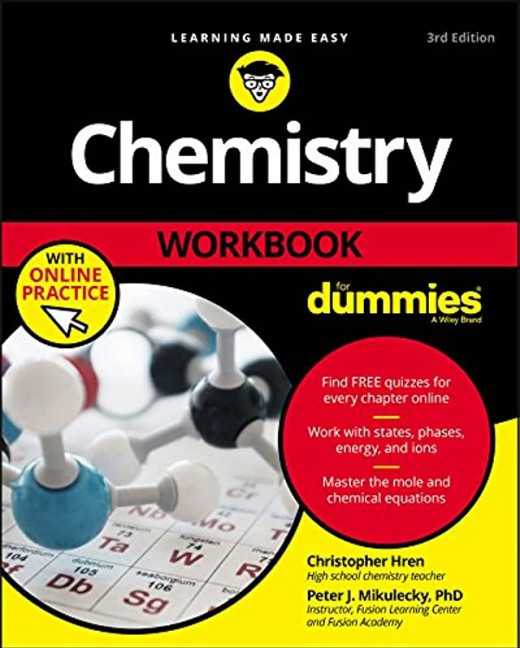
Chemistry Workbook For Dummies
Chemistry Workbook For Dummies by Chris Hren and Peter Mikulecky is considered one of the best chemistry book, which has helped a lot of students improve their chemistry understanding.
It is an ideal book for self learners and beginners, and is considered as one of the best chemistry book. This book can be used by high school students or college-level chemistry students.
The book has several practice chemistry problems, that offers you an opportunity to learn the basic principles that form the basis of chemistry.
Whether you are studying for exams or looking for a comprehensive study guide, this chemistry book is your passport for success in chemistry.
2. Chemistry: A Molecular Approach

Chemistry: A Molecular Approach
Chemistry: A Molecular Approach is another best chemistry for learners and tutors. The book focuses on making the students able to develop an excellent critical thinking and problem solving skills.
The 5th Edition of Chemistry: A Molecular Approach book combines digital innovation with educational research insights to produce a dynamic, and user-friendly framework for chemistry students.
The book also comes with a media package that simplifies the course setup. This book also allows professors and teachers to effortlessly and efficiently teach chemistry. It visualizes chemistry through images to highlight the interrelationship between atoms, and molecules that make up the world, and their formulas. It is a good book worth buying.
This book has also many worked examples with detailed explanations to enable students to master chemistry problems and how they can solve them in an easy way. The author employs a systematic approach to build this book.
3. General Chemistry: Principles and Modern Applications

General Chemistry: Principles and Modern Applications
General Chemistry: Principles and Modern Applications, is another go to book for chemistry learners studying organic chemistry, analytical chemistry, general chemistry, organic and biological chemistry. The book was published by Ralph Petrucci, F.Herring, Jeffrey Madura, Carey Bissonnette.
This book is considered the best because of its exceptional problems, straightforward writing, and clarity of reasoning in chemistry. The book equips students with visual learning skills to help them overcome chemistry obstacles of assessment and problem-solving.
4. Chemistry: Atoms First

Chemistry: Atoms First
Chemistry: Atoms First is another best chemistry book for learners and professors. The book was published by Julia Burdge and Jason Overby.
This book equips students with a systematic and logical introduction to chemistry. It starts with the atomic structure, which act as an essential building block of matter.
Once you’ve understood the atomic structure (electrons and atoms), the book takes you to the formation of compounds, where it discusses the properties of these compounds.
5. Chemistry: The Molecular Nature of Matter

Chemistry: The Molecular Nature of Matter
Chemistry: The Molecular Nature of Matter is another best chemistry book to go for. This book was published by Neil Jespersen, Alison Hyslop, and James Brady. It has an easy to understand chemistry concepts and can be used by college and high school chemistry students who want to learn the introductory chemistry essentials.
This book equips students with the skills they need to study and understand Chemistry-chemical bonding, chemical engineering, molecular, or molecular geometry. The book promotes competency and success among students by providing them with basic skills that enable them to understand chemistry.
How Does Bitcoin Work

All You Need to Know About Bitcoin
What is Bitcoin?
Bitcoin is a digital (cryptocurrency) virtual currency that can be transferred on the peer-to-peer bitcoin network acting as a form of payment outside personal's control.
Bitcoin is a virtual currency which operates freely without the oversight of banks or governments or any central control. It is the first and most valuable cryptocurrency around the world.
This article will provide in detail on all what you need to know about Bitcoin.
Satoshi Nakamoto who is a developer introduced Bitcoin virtual currency in 2009 and for any person to transfer virtual currency, first need to create a Blockchain account as Bitcoin uses blockchain technology to transact any digital currency from peer-to-peer between users on a decentralized network.
Cryptocurrency miners get rewarded when validating transactions which are authenticated through Bitcoin’s proof-of-work consensus mechanism.
How Does Bitcoin work?
Each Bitcoin is a digital virtual asset which anyone can store it as a cryptocurrency exchange or in a digital wallet. The the value of Bitcoin’s current price is represented by each individual coin.
In the virtual currency Bitcoin world, the smallest denomination of each Bitcoin is known as Satoshi, which shares its name with Bitcoin’s creator.
Each individual coin represents the value of Bitcoin’s current price, but you could also own partial shares of each virtual coin.
Each Satoshi is equivalent to a hundred millionth of one Bitcoin, so owning fractional shares of Bitcoin is quite common.
All transactions are recommended in the Blockchain wallet account. Bitcoin wallet has a public key & a private key, which work together to allow the owner of Bitcoin to initiate and digitally sign transactions. This unlocks the central function of Bitcoin securely transferring ownership from one user to another.
Bitcoin mining
When people are transacting the Bitcoin virtual currencies through peer to peer, all transcriptions are verified by people, who are known as miners in a process known as mining, which is designed to confirm that, every new transactions are consistent with other transactions that have been completed in the past. This ensures that you can’t spend a Bitcoin you don’t have, or that you have previously spent.
The value of Bitcoin virtual currency fluctuates over time, thus you can have a Bitcoin which values less today, but after a certain period attains a higher value. Whether or not Bitcoin is a good investment for you depends on your individual circumstances.
Advantages of Bitcoin
1. Cost-efficient
Transactions in Bitcoin are cost efficient and fast. When you have curtail currency in your Bitcoin wallet, you can make transfer virtual currency anytime, anywhere, reducing the time and potential expense of any transaction.
2. Privacy
Any transaction in Bitcoin does not contain personal information, such as a name or credit card number, which makes the transactions more private than credit card transactions.
3. Decentralization
When there is a financial crisis or a Great Recession, some investors become eager to embrace an alternative, decentralized currency.
4. Growth potential
Just as we have earlier said the value of Bitcoin fluctuates as it rises and falls and this makes some investors to buy Bitcoin and hold the virtual currency until the prices rise up and sell it at a higher price.
Disadvantages of trading in Bitcoin
1. Price volatility
The value of your Bitcoin in your wallet keeps on fluctuating as it rises and falls uncontrollably.
How are New Bitcoins Created?
Bitcoins are created by miners through a process known as ‘mining', which involves solving complex mathematical puzzle (called Proof-of-Work) before you as a miner can be allowed to put new transactions into the Blockchain. The rewards for solving the complex puzzle is new Bitcoin. For you to become miner, it's easy all you need is a computer and anyone can become a miner with proper setup. Once you become a miner, you can jointly validate and record transactions with other miners. The Bitcoin system becomes slow when only a few miners join up, and this result in in poor user experience. When more miners join up, the Bitcoin system will be too fast, resulting in security issues.
How Do You Buy Bitcoin?
Bitcoin can be bought if you are not familiar with the mining process. It can be bought using a cryptocurrency exchange. You can not buy an entire Bitcoin because of its price as it could cost you more dollars, but you can buy a portion of Bitcoin.
In conclusion, this article has explained what Bitcoin is and how it is created and transacted.
How to Make Chapati at Home
How to Make Chapati at Home
Chapati is a traditional flat bread that’s widely eaten in India and parts of Southeast Asia. It’s light, soft, and delicious - the perfect accompaniment to almost any meal. If you’ve never had chapati before, you’re missing out! Fortunately, making chapati at home is easier than it sounds. With a few simple ingredients and a bit of patience, you can have fresh chapati ready in no time.
In this article, we will go through the basics of how to make chapati at home - from kneading the dough to rolling and cooking your chapatis - so that you can enjoy an authentic Indian meal any time. Read on for all the details!
What is Chapati?
If you've ever been to an Indian restaurant, you've probably had chapati. Chapati is a flat bread that originates from the Indian subcontinent and is typically made from whole wheat flour, water, and salt. It's cooked on a griddle or in a skillet until it's nice and crispy.
Chapati is often served with curries or dals (lentil soup), but it can also be enjoyed on its own with a dollop of ghee (clarified butter). If you're feeling adventurous, you can even try making your own chapati at home! Here's how:
Ingredients Needed for Chapati
To make chapati, you will need:
- 1 cup of whole wheat flour
- 1/2 cup of water
- 1/4 teaspoon of salt
- 1 tablespoon of oil or ghee
- Additional flour for dusting (optional)
The Process of Making Chapati
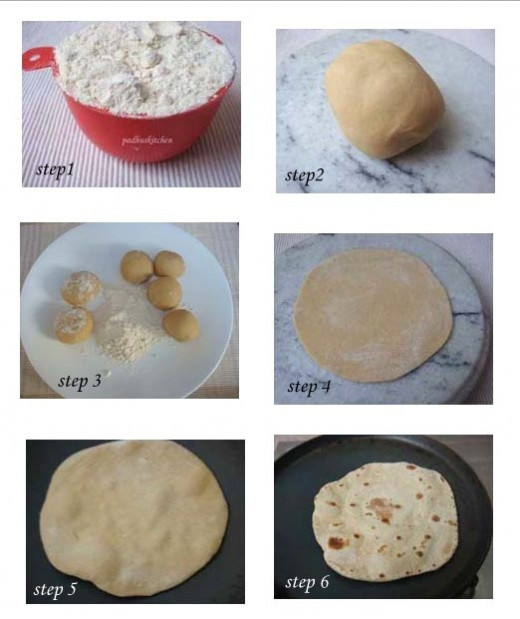
The process of making chapati is not difficult, but it does require some practice to get the dough consistency and rolling technique just right. Here is a step-by-step guide to making chapatis:
- Combine the whole wheat flour, water, and salt in a large bowl and mix together until it forms a soft dough. If the dough is too dry, add more water; if it is too wet, add more flour. Knead the dough for about 5 minutes until it is smooth and elastic.
- Cover the dough with a damp cloth and let it rest for 30 minutes. This will allow the gluten in the flour to relax, making the dough easier to work with.
- After resting, divide the dough into 12-16 equal balls. Keep them covered so they don't dry out.
- On a lightly floured surface, roll each ball of dough into a thin circle about 6-8 inches in diameter. The thinner you roll the chapatis, the softer and more pliable they will be once cooked. Be careful not to make them too
In conclusion, making chapati at home is an easy, fun and delicious way to enjoy a classic Indian dish without having to go out. With our step-by-step guide, you can start making your own chapatis from scratch in no time! Not only will this save you money, but it also allows for more creative freedom when creating different types of dishes. If you're feeling adventurous, why not try adding some spices or other ingredients to the dough? There are many ways to make chapati even more enjoyable. Bon Appetit!
5 Tips to Get Pregnant After Miscarriage

5 Tips to Get Pregnant After Miscarriage
Miscarriages can be very difficult to cope with, both emotionally and physically. It brings the feelings of guilt, sadness, and hopelessness. Getting pregnant again after a miscarriage may seem like an overwhelming challenge. After all, no one wants to go through the same pain twice. Fortunately, there are things you can do to increase your chances of getting pregnant again after miscarriage.
In this article, we will explore 5 tips which can help you to get pregnant after miscarriage and you will reclaim your hope for the future.
What is a miscarriage?
A miscarriage is the spontaneous loss of a pregnancy before the 20th week. Studies show that about 10 to 20 percent of known pregnancies end in miscarriage. The actual number is likely to be higher because many miscarriages occur even before a woman even knows she’s pregnant.
There are many different ways to miscarry. Some women bleed heavily, while others can have only light spotting. Some women can have no symptoms of Miscarriage at all and only to find out they’ve miscarried when they have a follow-up ultrasound or their period arrives.
Miscarriage can be incredibly painful, both physically and emotionally. Many women who miscarry feel guilty, even though it’s not their fault. Others feel like they’ve failed in some way. And some feel that their body has betrayed them. All of these feelings are normal. It can take time to work through them and heal emotionally from your loss.
If you’ve had a miscarriage, you might be wondering if there’s anything you can do to prevent it from happening again in your future pregnancy. While there’s no guaranteed way to prevent miscarriage, there are things you can do that may lower your risk and some of them are:
- Getting regular exercise during pregnancy
- Eating a healthy diet
- Avoiding harmful substances like tobacco smoke, alcohol, and drugs
- Managing your chronic conditions like diabetes
- Getting early prenatal care
Causes of Miscarriage
There are many different causes of miscarriages, the common ones are:
- Hormonal imbalances in your body: This is often causes early miscarriages (before 12 weeks). If your hormone levels are not balanced in your body, it can lead to the development of abnormal embryos.
- Chromosomal abnormalities: These occur when there are problems with the chromosomes in the embryo. This is the common cause of miscarriages after 12 weeks.
- Uterine abnormalities: If your uterus is not shaped correctly or if there are abnormalities in the way it contracts, it can lead to miscarrying. Uterine fibroids are one example of this.
- Lifestyle factors: Smoking, drinking alcohol, and using drugs can all increase your risk of miscarrying. Being overweight or obese can also lead to problems with implantation and increased risk of miscarriage.
If you have had a miscarriage, it is important to talk to your doctor about what might have caused it. They will help you determine if there is anything you can do to improve your chances of getting pregnant in the future.
How to Heal After a Miscarriage
It can take some time to heal after a miscarriage. Here are some tips which can help you:
- Give yourself time to grieve. It’s okay to cry, to be angry, or to feel scared. These are all normal reactions to loss. You should allow yourself to feel whatever you need to, and don’t try to bottle up your emotions.
- Talk about your feelings. Share your experience with someone who will understand and offer support, such as a close friend or a family member. If you don’t feel comfortable talking about it with others, consider writing about your miscarriage in a journal.
- Seek professional help if needed. If you find out that you’re struggling to cope with your feelings, don’t hesitate to reach out for professional help from a counselor or therapist.
- Take care of yourself physically. Eating healthy foods, getting regular exercise, and getting enough sleep are all important for helping your body recover from the physical stress of miscarrying.
- Stay connected with other women who have been through similar experiences. There are many online and in-person support groups available for women who have had miscarriages. Talking to others who can understand what you’re going through can be very helpful to you.
5 Tips to Get Pregnant After Miscarriage
If you have experienced a miscarriage, you may be wondering what best next steps you can take for you to become pregnant again. Here are some tips which will help you increase your chances of becoming pregnant again after a miscarriage:
- Talk to your doctor: Before you can try to conceive again, it is important to talk to your doctor. Doctor can ensure you medical complications you have, that caused your miscarriage. Your doctor will also provide you guidance on how long you should wait before trying to conceive again.
- Manage your stress levels: Stress can impact fertility, so its important for you to find ways to manage your stress levels when trying to become pregnant again. This may include relaxation techniques such as yoga or meditation, or simply spending time with loved ones and focusing on positive thinking.
- Eat a healthy diet: Eating a nutritious diet rich in fruits, vegetables, and whole grains can improve your fertility and increase the chances of a successful pregnancy.
- Get regular exercise: Exercise can help to improve your fertility by reducing stress levels and improving blood circulation throughout the body – both of which are important for reproductive health.
- Take prenatal vitamins: Taking a daily prenatal vitamin supplement can help you to reduce the risk of miscarrying again and they help you to improve overall health condition for your body during pregnancy.
In conclusion, miscarriage can be a difficult experience for anyone, and getting pregnant again after miscarriage can feel daunting. However, with the right tips and resources, you can make sure your chances of having a successful pregnancy are maximized. We hope that our 5 tips for you to get pregnant after miscarriage have been helpful in guiding you on how to take care of yourself during this time and how to increase your chances of conceiving for another child. With these tips in your mind, we wish you all the best as you embark on this journey!
7 Tips to Winterize Your Home

7 Tips to Winterize Your Home
Winter is here, and you know what that means. It’s time to get your home ready for the cold weather. From checking your heating system to putting caulking around windows, there are many small things that can make a big difference when it comes to winterizing your home. But what if you don’t know where to start? Don’t worry - in this article we will be going over 7 essential tips on how to winterize your home quickly and efficiently. From simple repairs and upgrades to inspecting smoke detectors, read on and find out how you can keep your house warm and cozy all season long.
7 Tips to Winterize Your Home
1. Get a Home Energy Audit
No one wants to see their energy bills skyrocket during the winter months. One way to avoid this is by getting a home energy audit. This will help you identify areas where your home is losing heat and what improvements can be made to increase its efficiency.
There are a few different ways to go about getting a home energy audit. You can hire a professional company, or you can do it yourself with the help of an online tool like the Home Energy Saver from the U.S. Department of Energy.
A professional energy audit will usually cost between $200 and $500. The auditor will come to your home and evaluate how well it is insulated and sealed, as well as look at your heating and cooling systems. They will then provide you with a report that outlines what improvements can be made.
If you decide to do an energy audit yourself, there are a few things you need to keep in mind. First, make sure you have an accurate idea of your square footage so that you can properly assess your insulation needs. Second, take some time to learn about the different types of insulation so that you can choose the most appropriate material for your home. Finally, don't forget to check for air leaks around doors and windows - these can be big culprits when it comes to heat loss!
2. Install Storm Doors and Windows
If you don't have storm doors or windows, now is the time to install them. Storm doors and windows provide an extra layer of protection against the elements, helping to keep your home warm and dry during the winter months.
3. Seal Up Cracks and Gaps
As temperatures start to drop, it's important to take steps to winterize your home and prevent drafts. A drafty home can be uncomfortable and expensive, as heat escapes through cracks and gaps in the structure. One of the best ways to prevent drafts is to caulk and seal air leaks.
Start by doing a walk-through of your home, both inside and out, to look for any gaps or cracks where air could be escaping. Pay special attention to areas around doors and windows, as well as places where utilities enter the home. Once you've identified all the potential air leaks, seal them with caulk or weatherstripping.
Caulking is a great option for sealing cracks and gaps around doors and windows. It's important to choose the right type of caulk for the job - there are different formulas for different materials (wood, metal, plastic, etc.). Weatherstripping is another effective way to seal door and window openings, and it comes in a variety of styles to suit different needs.
Take care of drafts now and you'll be rewarded with a warmer, more comfortable home all winter long!
4. Insulate Your Home
One of the best ways to winterize your home is to make sure it is properly insulated. This will help keep the heat in and the cold out, saving you money on your energy bills. There are a number of ways to insulate your home, including installing insulation in your walls and attic, sealing any gaps or cracks around doors and windows, and weather-stripping doors and windows.
5. Install a Programmable Thermostat
A programmable thermostat is a great way to save money on your heating bill this winter. By setting the temperature lower when you are away from home or asleep, you can cut down on the amount of time your furnace has to run. Follow these steps to install a programmable thermostat in your home:
- Choose a location for the thermostat. It should be placed on an exterior wall away from any windows or doors.
- Remove the old thermostat. Carefully disconnect the wires from the terminals, being sure to label them so you know where they go back on the new thermostat.
- Install the new thermostat according to the manufacturer’s instructions. This will usually involve attaching it to the wall with screws and then connecting the wires to their respective terminals.
- Set the temperature schedule according to your needs. Many programmable thermostats allow you to set different temperatures for different times of day and days of the week.
6. Use Ceiling Fans Year-Round
Ceiling fans are a great way to keep your home comfortable all year round. In the winter, ceiling fans can help circulate warm air and in the summer they can create a cooling breeze. Ceiling fans are also relatively inexpensive to run, so using them year-round is a great way to save on energy costs.
7. Add Weather-Stripping to Exterior Doors
One of the best ways to winterize your home is to add weather-stripping to your exterior doors. This will help to seal out the cold air and keep your home nice and cozy. You can find weather-stripping at most hardware stores, and it’s relatively easy to install. Just be sure to measure your door before you buy so you get the right size!
In conclusion, winter fast approaching, it is essential to take the necessary steps to winterize your home. These 7 tips are easy and cost-effective ways to ensure that your home remains comfortable throughout the coldest months of the year. Taking these steps now will help you avoid costly repairs in the future as well as minimize energy costs associated with heating a drafty home. Make sure you give your home a thorough checkup before temperatures drop so that you can enjoy a cozy and warm winter season!
5 Tips to be Successful in a Job Interview

5 Tips to be Successful in a Job Interview
Landing a job is easier said than done—especially in today’s competitive employment market. You need to make sure that you stand out from the rest of the applicants and impress the interviewer if you want to land the job. But how? In this article, we will cover five essential tips that can help increase your chances of succeeding in a job interview. From researching the company thoroughly beforehand to managing your body language and more, these tips are sure to give you an edge when it comes to making a great first impression. So read on as we dive into the nitty-gritty of acing that job interview!
1. Research the company you're interviewing with
When preparing for a job interview, it is essential to research the company you are interviewing with. This will allow you to ask informed questions and demonstrate your knowledge and interest in the organization.
To start, visit the company's website and read through their About Us page. Take note of their mission statement, values, and history. Then, check out their blog or news section to stay up-to-date on recent projects or initiatives. Finally, take a look at their social media accounts to get a sense of their culture and voice.
All of this research will not only help you prepare better for the interview, but it will also show the interviewer that you are truly interested in working for their company.
2. Arrive early to your interview
If you want to make a good impression, arrive early to your interview. This will show that you're excited about the opportunity and willing to put in the extra effort. Furthermore, it will give you a chance to relax and collect your thoughts before the interview begins.
3. Dress for success
The first step to nailing a job interview is to dress the part. Whether you’re going for a traditional, corporate look or something more modern, it’s important to send the right message with your appearance.
Your clothing should be clean and wrinkle-free, and it should fit well. Avoid wearing anything too revealing or that makes you feel uncomfortable; you want to be able to focus on the interview, not worry about your clothes.
If you’re unsure what to wear, err on the side of caution and choose something conservative. It’s better to be overdressed than underdressed for an interview.
4. Prepare questions to ask your interviewer
Your interview is just as much an opportunity for you to assess the company and position as it is for the employer to assess you. Coming prepared with thoughtful questions shows that you're interested in the role and want to know more about what it would entail. It also demonstrates that you've done your research and are serious about the opportunity.
Some good questions to ask include:
- What are the biggest challenges someone in this role would face?
- What kind of growth potential does this position offer?
- What kind of team will I be working with?
- What are the company's values and how do they guide day-to-day decision making?
Avoid asking questions that could easily be answered by a quick Google search or that come across as negative, like "What do you think are our company's weaknesses?" You want to present yourself as eager and positive, so focus on questions that will show off your skills and highlight your interest in the role.
5. Follow up after your interview
After your job interview, there are a few key things you should do in order to follow up and improve your chances of being hired.
First, send a thank-you email to the interviewer or hiring manager within 24 hours of your interview. This will show that you’re grateful for the opportunity and interested in the position.
Next, reach out to any contacts you made during the interview process and thank them for their time as well. Keeping in touch with these people can help you stay top of mind when it comes to hiring decisions.
Finally, take some time to reflect on your performance in the interview and identify any areas where you could have done better. Then, use this feedback to prepare for future interviews and increase your chances of being hired.
In conclusion, preparing for the job interview process can be a daunting and intimidating task, but with the right tips, it doesn't have to be. We hope that our 5 tips for successful job interviews have given you some great ideas on how to ensure your success in the interview room. Put these tips into practice and you will soon find yourself one step closer to landing your dream job!
13 Best Websites Where Students Can Sell Their Notes or Study Materials For Cash

It is a desire for every college, high school and secondary school student to have enough pocket money, which could sustain him/her at school or college. Much as this is the case, not every student is able to have enough financial resources which could make his/her life easier while a student.
A lot of students depend on their parents or relatives to support them in their educational journey, starting with the school fees and any extra learning resources which may be required in their educational path. While this is the case, some students have to struggle themselves to find financial resources which they need to support them in their educational journey.
As a student, it is inevitable to find ways of solving the financial problems which one is facing, in case of little support is given from parents or guidance. One of the ways of minimizing the financial problem while at school is by developing entrepreneurial thinking in you while at school. As a student, entrepreneur, your task is to find ways which could make every resource you have meaningful and profitable. One of it is by selling fresh or old school notes, past papers, questions and answers materials to online sites which buy students' notes or help them sell for cash. As a student, taking notes involves sacrificing your notes which could otherwise be used in other alternatives which could bring best outcome, as such there is a need to convert the sacrificed time, which you had for taking notes.
This article will look at 13 best sites where you can sell school notes and earn cash quickly, which could help you mitigating the financial problems.
1. STUVIA
Stuvivia.com is one of the common websites which is able to turn students' notes for cash. With a few easy to follow steps, one is able to upload his/her school notes or any learning materials and start making money instantly. This site claims that, majority of its note sellers are able to make an average of $103 a month. When uploading your learning materials, as the owner of the learning documents, Stuvia.com allows you to set up your price which could compensate your time spent on those materials. After uploading, Stuvia market it on your behalf on its site.
2. DOCMERIT
Docmerit.com is a site which enables the students to set their prices when uploading their note to compensate their time spent in preparing them. It takes less minutes to have your notes uploaded and be waiting for cash. Any cash, which is made by you at this site, can be withdrawn within 24 hours, which is good. At Docmerit.com students are able to take a revenue share of 85% and the remaining %15 is taken by the site owner for offering you their selling services.
3. NEXUS NOTES
Nexusnotes.com is able to accept almost all learning school resources (essays, school notes, questions and model answers, among others) and help you turn it/them into cash. This site claims that, majority of its sellers are able to make an average of $83.33 a month and they could make $1000 annually. At Nexusnotes.com as a note seller, you have got two options, one is to turn your notes for cash and the second one is to exchange your upload with free unlock which enables you to have access of reading learning resources uploaded by other students or sellers.
4. ONECLASS
Oneclass.com enables students to earn 25 points per upload which could be converted to cash. At ONECLASS, a student has got a chance to apply to be a note taker for certain course and once an application is successful, one has a potential of earning up to $470 per class basis. This site also offers you with an opportunity to participate in answering students questions which enables you to earn points which can be converted to cash or other gifts. This site also offers you a reference letter when you become successful in your application to become a note taker and this can be used when applying other job vacancies.
5. OXBRIDGE NOTES
Oxbridgenotes.com is a UK based site which enables students across the world to sell their notes for cash. The site pays you 50% of the sell, it makes for your notes and the other 50% it takes for the services it offer in helping you sell your notes on its site. The site claims that the majority of its users make a yearly average of $250. For students to sell their notes at Oxbridge notes, they apply first and whenever they become successful they then start selling their notes.
6. GRADEBUDDY
Gradebuddy.com is another website which enables students to sell their notes for cash. It offers free upload and notes upload owners have the potential to earn up to $500 a week. At Gradebuddy you can upload to sell your notes and study materials, just to mention a few.
7. NOTESALE
Notesale.com is a site that offers students an access to sell their notes for cash in an easy way. The site enables you to set your preferred price to sell your notes and you provide a little information for your notes, which among others include, the title, course name and description.
8. STUDYSOUP
Studysoup.com enables students to sell their notes for the entire course after applying to be elite notes taker, which is easy to complete as it just requires basic information filling like your school name, your full name etc. After getting approved, you attend an online training before starting selling your notes. This training takes an average of 30 minutes to be completed. This site claims that students earn $5 per notes upload and the majority of students who sells their notes there are able to make up to $500 per month.
9. STUDYPOOL
Studypool.com is another site which claims to pay its users who are interested in selling their school notes, questions and answers, study books, among others. The site claims that, top note sellers are able to make up to $5000 per months. After uploading your notes, it takes a range of 0.5 to 48 hours for your the notes to get approved. This site claims that, each document you upload has a potential to earn up to $10 per view.
10. COURSE HERO
Coursehero.com is a site which enables the students to upload notes, just for free unlock which gives them access to download learning materials which they want using the free unlock which they get while uploading their notes. The site compensate tutors with cash for uploading learning materials, but this is not the case with students who just get free unlock.
11. Notesgen
Notesgen.com is a site which pays note sellers 60% of the revenue it generate from your notes. The site buys and sells notes. The site offers an easy to use platform and also is able to connect different students across the globe which make them easy to exchange their notes and study materials. Any revenue, which a student makes through selling is paid every Friday.
12. Notesmate
Notesmate.com enable the students to sell their notes for cash through its app. Any student who is interested in selling their notes are requested to download and install an application. Once an application is installed, students are able to upload their notes and sell and on top of this the app offers a social platform which allows users to be following each other.
13. NoteXchange
Notexchange.com enables students to upload their notes for cash and is able to share 50% of its revenue it generate from selling their notes. After uploading your notes, you wait a few hours for your notes to be reviewed and approved.
In conclusion, this article has discussed 13 sites which enable students to sell their notes, study materials and questions and model answers for cash, which can help them improve their living standards.
Descriptive Statistics

Descriptive Statistics
In this article you will learn about descriptive statistics where basically you will learn how to summarize and organize data. Specifically under organization and summarization of data you will learn about organizing and summarizing data using tables and graphs.
In the article you will also specifically learn about summarizing data using numerical summaries like measures of centre, location and dispersion. The article is important as it
provides you preminary data analysis tools before carrying out inferential statistics.
Basic Statistical Terms
- Data consists of information coming from observations, counts, measurements, or responses. The singular of data is datum or data point.
- Statistics is the science of collection, organizing, analyzing and interpreting data in order to make decisions.
- A population is a collection of all items of interest in the study. For example, lets say you want to find out the mean height of statistics class, then the population include all students in the statistics class.
- A sample is a subset of a population. For example, to measure heights of students in the statistics class, we may not measure everyone probably due to time; so we take a subset of students. This subset is the sample.
- A parameter is a numerical description of a population characteristic. Examples include population mean which describe population center and population standard deviation which describe population variation.
- A statistic is a numerical description of a sample characteristic. Examples include sample mean describing sample centre and sample standard deviation which describe how sample values vary.
- Descriptive Statistics is the branch of statistics that involves the organization, summarization, and display of data.
- Inferential statistics is the branch of statistics that involves using a sample to draw conclusions about a population. Some of the problems concerned in inferential statistics are those of estimation and hypothesis testing.
- Data types: There are two types of data
- Qualitative and quantitative
- Qualitative data is non numeric data and is usually treated as categorical data.
This means the observed data values can be put into categories.
Examples of qualitative/categorical data include: gender data(male/female)
- Quantitative data is numeric data that arises from frequencies or measurements.
There are two types of quantitative data:
- Discrete and continuous
-Discrete Data: the data are said to be discrete if the measurements are integers (e.g. number of employees of a company, number of incorrect answers on a test, number of participants in a program, etc).
- Continuous Data: the data are said to be continuous if the measurements can take on any value, usually within some range (e.g. weight, age, income etc).
Summary of data using tables
A frequency table: is a list of possible values and their frequencies. It is used to summarize categorical data into tables to see frequency distribution for each category
Example
Group internet use data into group frequency table
7,7,11,17,17,18,19,20,21,22,23,28,29,29,30,30,31,31,33,34,36,37,39,39,39,40,41,41,42,44,44,46,50,51,53,54,54,56,56,56,59,62,67,69,72,73,77,78,80,88
Step 1: Find Range = Largest observation – Smallest observation
=88-7
=81.
Step 2: Find class width by dividing the range by the number of classes: Class width
≈Range/number of classes
Number of classes
A rule of thumb for the number of classes is √n. E.g number of classes =√50=7.0 71068
Thus class width ≈ Range/Number of classes = (88–7)/7=11.57 rounding up gives a class width of 12.
Step 3: Find class boundaries starting from lowest observation and adding class width to find upper limit. This gives boundaries of 7, 19, 31, 43, 55, 67, 79, and 91
NOTE: We will have the classes running from 7 to 19, etc where the upper bound is exclusive, i.e it does not include 19
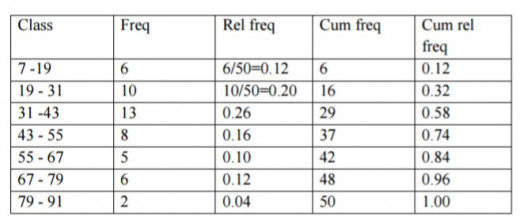
Step 3: For each class, count the number of observations that fall in that class. This number is called the class frequency.
Step 4: The relative frequency of a class is calculated by f/n where f is the frequency of the class and n is the number of observations in the data set.
Step 5: Find the cumulative frequency and cumulative relative cumulative frequency.
Graphical Summary of Data
Histogram
A histogram displays the frequency distribution of a quantitative variable by showing the frequency (count) or percent of the values that are in various classes.
The classes are typically intervals of numbers that cover the full range of the variable.
Histograms are used to assess the distribution of the quantitative variable.
To construct a histogram, group the data into a frequency table, i.e. put data into classes, and determine frequency for each class.
Plot class frequency against class intervals to have a histogram.
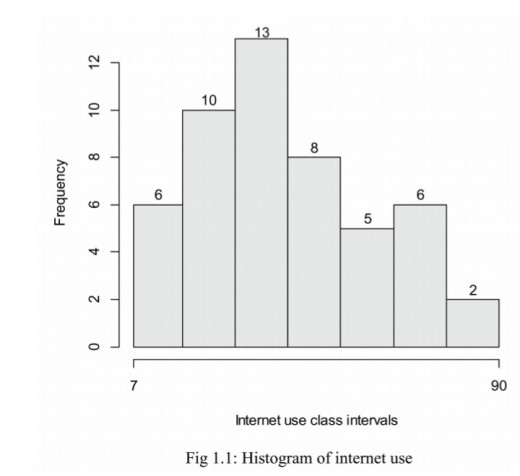
Shapes of the histograms
(a) Normal (symmetric)
A histogram has bell shape.

Fig 1.2: Normal shape of a histogram
The normal shape of histogram means that most data is clustered in the centre.
(b) Skewed (asymmetric)
The distribution’s peak is off center and a tail stretches away from it.
These distributions are called right or left-skewed according to the direction of the tail.
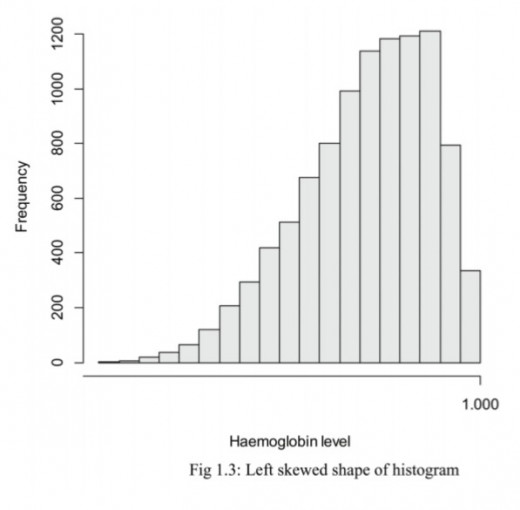

In the right skewed distribution it means most data is to the left and in the left skewed distribution it means most data is to the right.
(c) Bimodal
The bimodal distribution looks like the back of a two-humped camel.
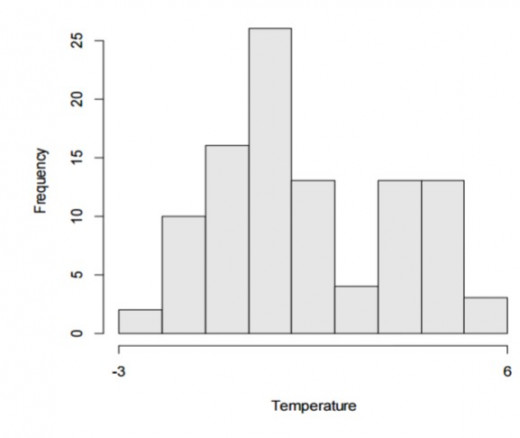
Fig 1.5: Bimodal shape of histogram
The bimodal distribution means that the data come from two district populations.
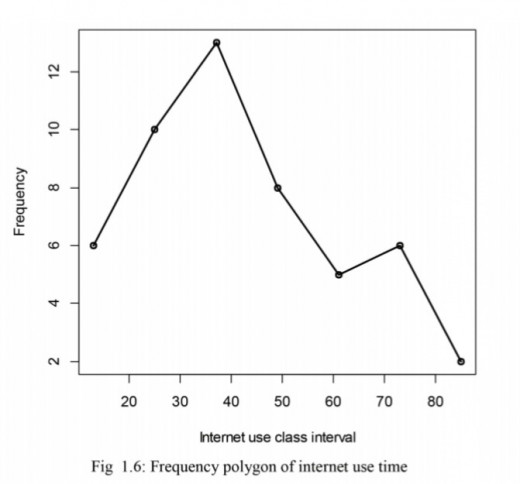
Frequency polygon
Is a line graph plotted by plotting frequency against class interval. It shows frequency distribution of classes by a line graph. For example the frequency polygon for internet use data is as shown below:
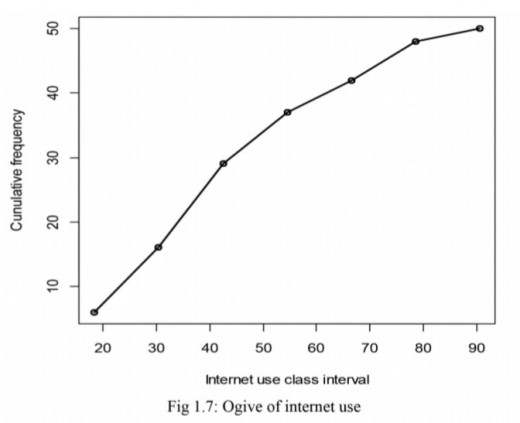
Ogive
Is a plot of cumulative frequency versus class intervals. The diagram below shows an ogive for internet use data.
Stem and leaf diagram
It is used to display the frequency distribution of quantitative data by showing actual data rather than frequencies.
Example
Draw stem and leaf diagram for the students scores:
35, 36, 38, 40, 42, 42, 44, 45, 45, 47, 48, 49, 50, 50, 50.
Solution
Range: 35 to 50
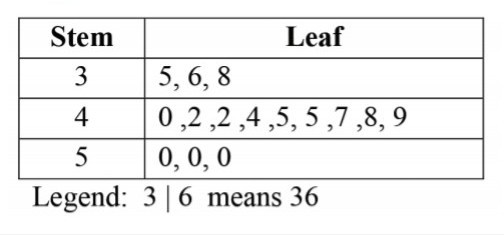
A stem-and-leaf plot shows the shape and distribution of data. It can be clearly seen in the diagram above that the data clusters around the row with a stem of 4. It is some how normal(ie most data is at the centre and a few towards the ends).
Bar graph
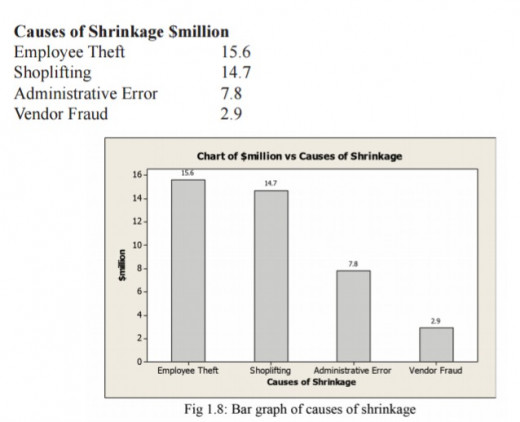
It is used to show graphical frequency distribution for a categorical variable.
Example
Draw the bar graph for the data below:
Pie chart
A pie is an alternative display of bar graph
Example
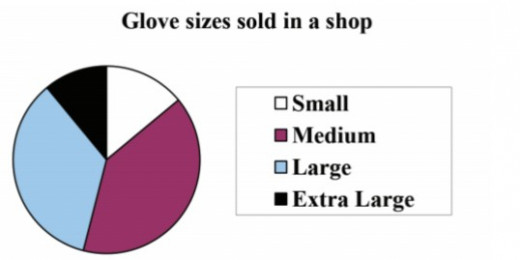
Draw the pie chart for the data in example above.
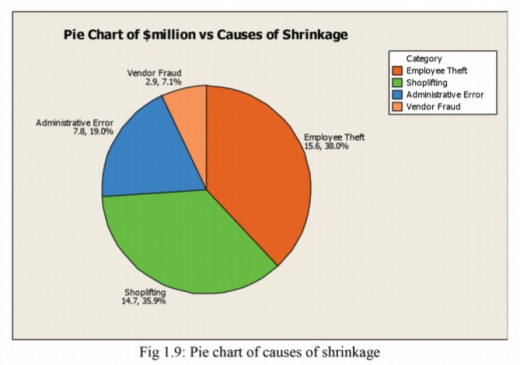
A pie chart is a circle with slices proportional to the relative frequency of each category. A Pie chart is made by representing the relative frequency of a category by an angle of a circle determined by:
Angle of a category = Relative frequency of the category
Relative frequency=f/n
Example
A shop sells different sizes of gloves. The table shows the percentage of gloves sold in a year that were each size
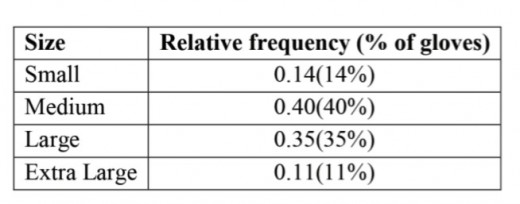
As the values are percentages, the total must be 100% (but check to make sure)
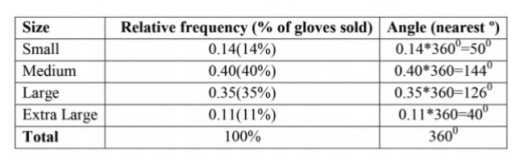
Note: Sometimes rounding the angles leads to a total angle of more or less than 360º.
If this happens, adjust the angle of the largest sector so that the total is correct e.g if the total comes to 361º, take 1º away from the largest angle.
Numerical summaries of data
Measures of central tendency
Definition: Given a series of observations measured on a quantitative variable, there is a general tendency among the values to cluster around a central value. Such clustering is called central tendency and measures put forward to measure these tendency are called measures of central tendency or averages.
Measures of the centre indicate where the center or the most typical value of the variable lies in collected set of measurements. Measures of center are often referred to as averages.
The mode
The sample mode of a qualitative or a discrete quantitative variable is that value of the variable which occurs with the greatest frequency in a data set.
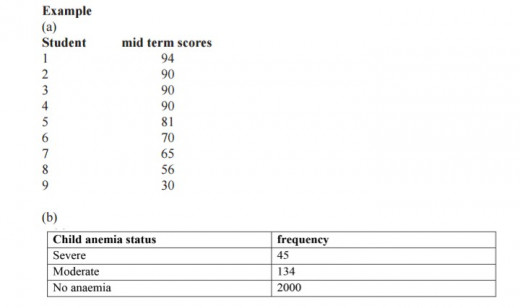
Find the mode in (a) and (b)?
Solution
(a) mode is 90 (b) mode is category no anaemia
Note that for a categorical variable, look at the category with highest frequency and for a quantitative (numeric) variable look at number with frequent occurrence.
The median
The sample median of a quantitative variable is that value of the variable in a data set that divides the set of observed values in half, so that the observed values in one half are less than or equal to the median value and the observed values in the other half are greater or equal to the median value. To obtain the median of the variable, we arrange observed values in a data set in increasing order and then determine the middle value in the ordered list.
If the number of observation is odd, then the sample median is the observed value exactly in the middle of the ordered list. If the number of observation is even, then the sample median is the number halfway between the two middle observed values in the ordered list. In both cases, if we let n denote the number of observations in a data set, then the sample median is at position (n+1)/2 in the ordered list.
Example
Seven participants in bike race had the following finishing times in minutes: 28,22,26,29,21,23,24. What is the median?
Solution
Medium is the middle observation in the ordered list 21,22,23,24,26,28,29 i.e 24.
What it means, half of the observations are less than or equal to 24 and half of the observations are more than or equal to 24(check).
How to Make Money Online With Bitcoin

5 Ways to Make Money With Cryptocurrency
A lot of people nowadays are opting for Bitcoin as a way to go for making money online. If your choice is to start making money with Bitcoin, this article is for you. This article will take a look at different ways how you can make money online with Bitcoin.
Learning different ways you can make money through Bitcoin will help you choose the best option that maximizes your returns.
5 Ways to Make Money With Cryptocurrency
The following are some of the ways you can use to make money online with Bitcoin:
1. Lending Bitcoin
An easy way to make money online with Bitcoin is by lending your Bitcoin to investors at an interest. You could be lending your Bitcoin to different investors on different websites to get quick cash through interest.
Bitcoin shareholders usually charge interest when offering Bitcoin to people, and they do so according to the agreement that two of you make. As a result, they will obtain some strong interest when lending Bitcoin.
As the owner of the Bitcoin, you can choose to lend your Bitcoin for short term or long term depending on the amount of Bitcoin you have in your Bitcoin wallet. The less you have the higher will be the payback period in most cases.
2. Bitcoin Mining
Bitcoin mining is a very popular way of getting Bitcoin and is used by many investors. To get Bitcoin through mining you need to solve complex mathematics problems using a powerful computer which has best hard drive. After solving complex mathematical problems and cracking codes, you earn some Bitcoin in your wallet.
For you to be a successful miner, you need to have more than just your typical home computer. To be successful in this you require some of the best equipment in order to mine Bitcoin.
3. Bitcoin Trading
If you plan to enter the Bitcoin market with a long-term investment goals, you should consider joining Bitcoin trading. To do this, you require basic knowledge about Bitcoin on how volatile the Bitcoin market is, which will enable you to take an advantage of that.
The more you make through Bitcoin trading relate to your personal knowledge and experience about Bitcoin trading.
4. Bitcoin Buying
Another way to make money online with Bitcoin is by buying Bitcoin and keeping it for some time to resell. It is considered as an easy way to make money with Bitcoin. This method is also very suitable for beginners.
To get started, you need to create a Bitcoin wallet and buy some Bitcoin into it. Once you put Bitcoin into your wallet, you should hold it for some time to resell it at a fair price when the market price goes up.
5. Bitcoin Affiliate Marketing
Bitcoin Affiliate Marketing is another easy way of earning Bitcoin. How this work is that, you invite your friends and families who you believe could invest in Bitcoin and they get registered through your Bitcoin Affiliate link, earning commission in return.
In conclusion, this article has taken a look at 5 ways you can make money online with Bitcoin.
Government Jobs vs. Private Jobs – Advantages and Disadvantages

Government Jobs vs. Private Jobs – Advantages and Disadvantages
As the world of work continues to evolve, there are many different career paths available to individuals. Two of them are government jobs and private jobs. Each type of these two jobs come with its own set of advantages and disadvantages.
In this article, we’ll take a look at the differences between the government jobs vs. private jobs. The article will also show you which option might be right for you. We’ll discuss what it takes to succeed in each kind of the job, as well as some tips on how you can best approach your job search.
Government Jobs
There are a lot of advantages and disadvantages of getting a government job as opposed to a getting a private job. It really depends on what you are looking for in your career. Some people prefer the stability and benefits that come with government jobs, while others prefer the higher pay and faster promotions of private sector jobs. Here is a list of some of the pros and cons of working for the government:
Advantages of Government Jobs
- Generally speaking, government jobs offer you more job security than private sector jobs. This is because in government, it is very difficult for you to get fired, even when you are not performing well in your job. While in the private sector, it is much easier for you to get fired when you are not performing well on your job.
- Government jobs also offers you better benefits than those in the private sector. This includes things like your health insurance, retirement plans, and paid vacation days, among others.
- Another advantage of government job is that, it often offers you a flexible work schedule. This can be great opportunity for you if you have a schooling children as you can be dropping your kids off at school or pick them up after extracurricular activities.
- Government jobs also tend to be less stressful than private sector jobs. This is because there is less pressure to make profits and meet deadlines, while private sector employees often have to work for so long and deal with a lot of stress.
- Finally, many people feel good when working for the government because they feel like they are making a positive difference in their society. They may feel like they are helping to protect their country financially.
Disadvantages of Government Jobs
- There are also some drawbacks of getting a government job. One of the drawback is the bureaucracy that can be involved in government jobs.
- In additional, government jobs can sometimes be very political, and employees who works on government may have to deal with office politics on a regular basis.
Private Jobs
There are a good number of advantages and disadvantages of private sector jobs. It is important to consider some factors when making a decision about which type of job to pursue.
Private sector jobs is more dynamic and is fast-paced than government jobs. It can offer you greater opportunities for your career advancement and higher salaries. However, it may also be less stable, with fewer benefits and protections.
Advantages of Private Jobs
- Money: Private sector jobs typically pays you more than government jobs. If you are looking to maximize your earnings potential, the private sector is often the way to go.
- Opportunity: There is more opportunity for advancement in the private sector than in government. In the private sector, it is often possible to move.
Disadvantages of Private Jobs
- Less stable
- Fewer benefits and protections.
Which one should you choose?
There are pros and cons to both government jobs and private sector jobs. It really depends on your priorities and what you are looking for in a job. If you want job security, good benefits, and a pension, then a government job may be the right choice for you. If you are looking for more money and more opportunity to advance, then the private sector may be a better option. Here are some things to consider when making your decision:
How to get a government job
- Start by researching the agencies that interest you. Each agency has its own mission, values, and goals. Find an agency whose work aligns with your interests and skills.
- Next, visit the agency’s website and look for job openings that match your qualifications. When you find a position that interests you, carefully read the qualifications and requirements before applying.
- Once you’ve found a position you’re interested in, follow the instructions on how to apply. The process can vary depending on the agency, but usually involves submitting an online application and supporting documents like your resume and cover letter.
- If you’re selected for an interview, congratulations! This means your qualifications have impressed the agency enough to move forward in the hiring process. Be prepared for your interview by
How to get a private job
There are many reasons why people choose to work in the private sector over the public sector. Private sector jobs often offer higher salaries, more flexible working hours, and greater opportunities for career advancement. However, there are also some disadvantages to working in the private sector, such as a lack of job security and benefits.
If you're looking for a job in the private sector, there are a few things you can do to increase your chances of landing a position. First, be sure to network with people who work in your desired field.
In conclusion, the decision to pursue a government job or private job is an individual choice that should depend on your needs and preferences. While government jobs may offer more security and stability, they usually lack the opportunities for advancement and creativity afforeded by private sector jobs. On the other hand, private companies often provide higher salaries and more flexible hours than their public counterparts but come with a greater risk of layoffs or reduced benefits due to market competition. Ultimately, it is up to you to decide which type of job best suits your lifestyle and career aspirations.
9 Best Places to Live in the US

9 Best Places to Live in the US
Doing a bit of research to find the best places to live in the US can be overwhelming. There are so many towns, cities and regions in United States (US) each with features that appeal to different people. Different visitors, have different feels and different choices, when it comes to choosing the best places for them to live in USA.
Whether you’re looking for a vibrant city life in US or a peaceful rural setting, this article will help you make an informed decision about where to live in the US. We’ll cover the 9 best places you can choose to live in US based on factors like weather, job opportunities available in the selected regions we are sharing with you, cost of living which you should expect, education level available in those towns and many more. Keep reading to learn more and make your move into the perfect location!
9 Best Places to Live in the US
The following are 9 best places you should stay in US:
1. Colorado
Colorado is the best place to live in US for and is an outdoor lover’s paradise. Most of the days in Colorado has sunshine with recent studies showing more than 300 days of sunshine. Which means if your final choice is to stay in Colorado then you will be likely to ski in the morning and golf in the afternoon. This state is home to 14 ski resorts, which includes; Vail, Aspen and Breckenridge, as well as world-class hiking, biking, climbing and camping.
The Rocky Mountains in Colorado provide a stunning backdrop for Colorado cities like Denver, Boulder and Fort Collins. With more than 100 state parks and 4 national parks located in this state, there’s no shortage of things for you to do outdoors.
Colorado is also known for its thriving arts and culture scene. Thus, the state is home to world-renowned museums like the Denver Art Museum and the Museum of Contemporary Art Denver. These places can make you enjoy plenty of outdoor festivals and concerts throughout the year, since this state also has more than 300 days of sunshine.
In summary, when you want to live in US and that you’re looking for a place to call it your home, because it offers you an active lifestyle and plenty of amenities, Colorado should be at the top of your list.
2. California
California is considered one of the best places in Us you can choose to live, just as Colorado. However, this place has also it's unique features, which makes it different from Colorado.
Firstly, the weather in California is very amazing. The people who stays in this state are also very friendly, and there are so many things you can to do in California.
California is also one of the best places for the outdoor lovers. In California there are plenty of opportunities for hiking, biking, and camping. This state has also some best beaches, where you can spend your leisure time on.
California has also great job markets compared to other states in Us. This state is also home to many major corporations, that make plenty of jobs to be always available.
In summary, if you're just looking for a place to relax and your enjoy life in US, then California should be definitely the place for you. There's no shortage of things which you can do, and you will find everything from world-class restaurants to beautiful parks.
3. Texas
Texas is another great place you can live in US and there are many reasons why you should choose Texas. Firstly, the cost of living in Texas is relatively low and there are plenty of job opportunities in this state, and the weather is also good.
Texas has also a lot to offer when it comes entertainment and recreation. There are many great restaurants, bars, and clubs where you can check out, and the state is home to some of the best beaches in the country. If you're looking for a place to call home, Texas should definitely be at the top of your list too.
4. New York
If you're looking for a bustling city with endless entertainment options, then New York should be the best place for you. This state has the bright lights and world-renown museums.
5. Florida
Florida is one of the most popular states in the US, for good number of reasons. Firstly, the weather in this state is great, and the beaches are also beautiful. If you’re looking for a great place where you can call your home, Florida should definitely be at the top of your list.
6. Illinois
Illinois is another great place you can live in US. Here are just a few of the reasons why Illinois should be on your choice: The cost of living in Illinois is relatively low, especially if we compare it, to other states in the Midwest region and Illinois has a very diverse economy, which means that, there are plenty of job opportunities available.
7. Michigan
Michigan has something for everyone, whether you're looking for a big city or a small town. Detroit is the largest city in Michigan and it's full of cultural attractions like the Detroit Institute of Arts and the Motown Museum.
There's also plenty of green space for you to enjoy, like Belle Isle Park and the Detroit RiverWalk. And don't forget about the food! Detroit is home to some of the best restaurants in the country, like Slow's Bar BQ and Supino Pizzeria.
8. Pennsylvania
Pennsylvania is another great place to live in US for many reasons. Firstly, the state has a rich history and culture, beautiful scenery, and plenty of things to do.
Pennsylvania is home to some of the best schools in the country, including Penn State University and the University of Pennsylvania. There are also many excellent private and public schools throughout the state.
The cost of living in Pennsylvania is relatively affordable. Housing costs are reasonable, and there are plenty of job opportunities available.
Pennsylvania is considered a great place to raise a family or retire. There are plenty of safe, family-friendly communities to choose from, and the state offers a high quality of life.
9. Ohio
Ohio is our last best place you can choose to stay in US. Here are just a few reasons why Ohio is considered the best place to live in the Us:
Firstly, the people in Ohio are incredibly friendly and welcoming. No matter where you go in the state, you’ll always feel like you’re at home.
The scenery in Ohio is absolutely beautiful. From the rolling hills of the countryside to the bustling city streets, there’s something for everyone.
Ohio is home to some of the best colleges and universities in the country. If you’re looking for a great education, Ohio is definitely the place to be.
There are endless things to do in Ohio, no matter what your interests are. Whether you love exploring nature or spending time in the city, you’ll never get bored here.
Ohio is an incredibly affordable place to live. You can find everything from affordable housing to great job opportunities without breaking the bank.
How to Decide Where to Live in the Us
If you’re looking to move the U.S., it’s important to understand the different characteristics that each state has to offer in order for you to make an informed decision. Below are some of the key factors that you should consider when deciding which state or city is right for you in the United States.
- climate - Do you prefer warm weather or cold weather? Do you want to experience all four seasons? Consider what kind of climate will make you most comfortable.
- cost of living - Make sure you can afford the cost of living in your desired location. Research the average rent and cost of groceries, transportation, and other necessities.
- job opportunities - If you're looking for a specific type of job, research which cities have the most opportunities in that field. Keep in mind that some cities have higher competition for jobs than others.
- lifestyle - Do you want to live in a big city or a small town? Consider the pace of life and what kind of lifestyle you want to lead.
- amenities - What type of amenities do you want access to? Do you need public transportation or good schools? Make sure your desired location has everything you need to be happy and comfortable.
In conclusion, finding the perfect place to live in the US can be a challenging task, but it is possible for you to find a best place, which will make your life happy. Our tips which we have shared in this article hopefully they have provided you with some ideas on how to decide where to live in the US and they have also given you insight into what types of things you should factor into your decision-making process. So take your time when researching different locations and consider what matters most before making a move. Good luck!